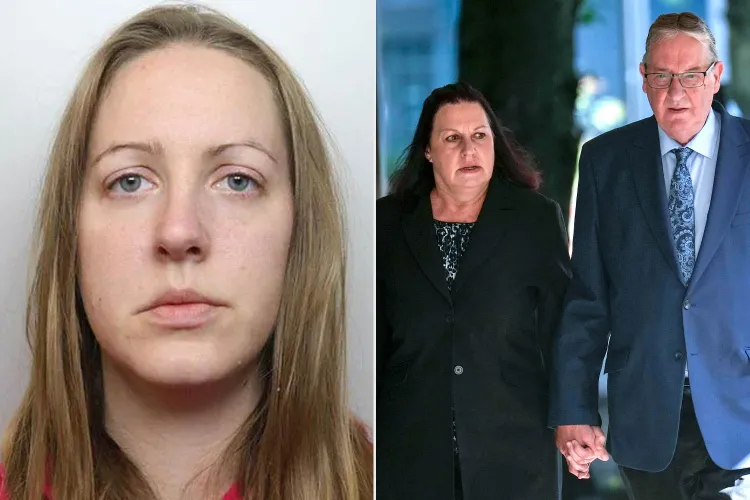
Lucy Letby, Lucy Letby's parents John Letby and Susan Letby. Credit : EyePress News/Shutterstock; Christopher Furlong/Getty
Credit : EyePress News/Shutterstock; Christopher Furlong/Getty
Susan and John Letby, the parents of convicted child killer Lucy Letby, have publicly condemned a Netflix documentary about their daughter’s crimes, calling it “a complete invasion of privacy” and saying they will never watch it. Their protest has reignited a difficult question that follows every major true crime production: where does the public’s right to know end and a family’s right to privacy begin?
Lucy Letby, a former neonatal nurse at the Countess of Chester Hospital, was convicted in August 2023 of murdering seven babies and attempting to murder six others between June 2015 and June 2016. She was sentenced to whole-life imprisonment. In July 2024, she was found guilty of the attempted murder of a further child. The case remains one of the most shocking criminal prosecutions in modern British history.
What the Netflix documentary contains
The documentary, titled The Investigation of Lucy Letby, runs one hour and 35 minutes and is rated TV-14. Netflix has promoted it as a deep look at the police investigation, built around previously unreleased material including interview recordings, case files and footage from inside the Letby family home captured when officers arrived to arrest their daughter.
That arrest footage is a central selling point. The trailer shows officers entering the family’s property and confronting Letby while she was in her bedroom. The material appears to originate from police body-worn cameras, a detail that matters legally and ethically because it was recorded by law enforcement, not by a film crew invited inside by the family.
The parents’ reaction: “It would likely kill us”
Susan and John Letby have not held back. In statements reported by People magazine and other outlets earlier this year, they said they refuse to watch the film, explaining that doing so “would likely kill us.” They said they had no idea footage recorded inside their home would end up in a streaming release available to millions of subscribers worldwide.
“All this taking place in our house while she was in her bedroom,” they said, according to The Independent. They described the experience as a second wave of trauma on top of the original devastation of learning what their daughter had done. For them, every time the trailer auto-plays on a screen, the worst moment of their lives is replayed as content.
“A complete invasion of privacy”
The couple have called the documentary “a complete invasion of privacy,” arguing that their home should not serve as a set piece for a streaming audience, regardless of the seriousness of the subject. Their objection is not a formal legal challenge, at least not yet. It is a raw, personal protest from two people who feel their private space was turned into public spectacle without meaningful consent.
The legal picture around police body-worn camera footage in England and Wales is not straightforward. Forces can release such material to third parties, including documentary makers, but are expected to consider privacy implications under the Data Protection Act 2018 and the UK General Data Protection Regulation. Whether the footage was released directly to the filmmakers or obtained through other channels has not been publicly clarified by either Cheshire Constabulary or the production team.
Accusations against the lead detective
The Letbys’ criticism extends beyond the cameras. They have also taken aim at Detective Superintendent Paul Hughes, who led the investigation, claiming he appeared to hold a “deep hatred” toward them. Their remarks, reported by The Guardian, frame the documentary as not just invasive but slanted, with a senior officer they view as hostile given a prominent platform.
Neither Det Supt Hughes nor Cheshire Constabulary has publicly responded to the parents’ characterization. Netflix has also not issued a detailed public statement addressing the family’s specific complaints. Those silences leave the parents’ account as the dominant narrative in the dispute so far, but also mean key questions about editorial decisions and footage sourcing remain unanswered.
The victims’ families and the broader stakes
Any discussion of the Letby parents’ distress exists alongside a far larger grief: that of the families whose babies were killed or harmed. Several of those families gave victim impact statements during sentencing, describing losses that will define the rest of their lives. Some have spoken publicly in favor of transparency around the case, arguing that a full accounting of what happened at the Countess of Chester Hospital serves the public interest.
That tension is not easy to resolve. The parents of a convicted killer are not responsible for her crimes, but their desire for privacy inevitably collides with the public’s interest in understanding how those crimes were investigated and prosecuted. True crime documentaries sit squarely in that collision zone, and the Letby case, because of its severity and the emotions it provokes, makes the friction especially intense.
True crime’s recurring ethical problem
The backlash against The Investigation of Lucy Letby is not an isolated incident. Netflix and other platforms have faced similar criticism over documentaries about cases ranging from Jeffrey Dahmer to Madeleine McCann, with affected families arguing that their pain is being monetized for subscriber engagement. The streaming model, which rewards provocative trailers and autoplay previews, can amplify that sense of exploitation by pushing content in front of viewers who never sought it out.
At the same time, well-made documentaries about criminal cases have driven accountability, exposed failures in policing and hospital governance, and given the public access to information that official channels were slow to release. The question is rarely whether such projects should exist at all, but whether the people caught in their orbit were treated with adequate care during production.
In the Letby case, that question remains open. Until Netflix or the filmmakers address the family’s specific claims about consent and footage use, the dispute will continue to overshadow the documentary itself.
About the Author