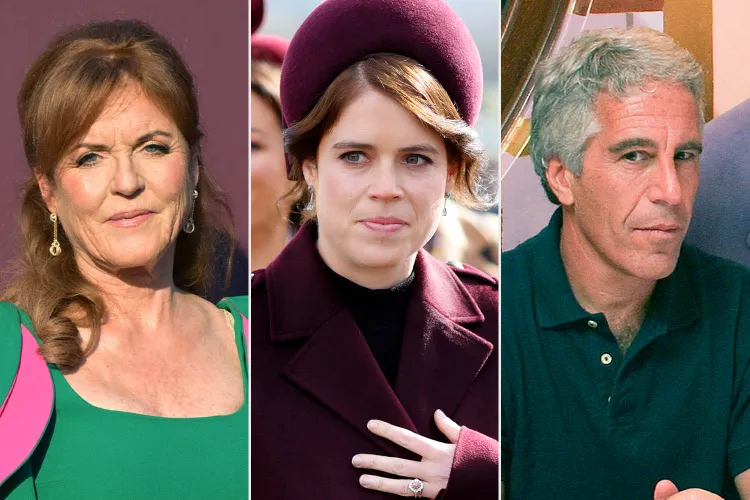
Sarah Ferguson; Princess Eugenie; Jeffrey Epstein. Credit : Stephane Cardinale - Corbis/Corbis via Getty; Max Mumby/Indigo/Getty; Rick Friedman/Corbis via Getty
Credit : Stephane Cardinale – Corbis/Corbis via Getty; Max Mumby/Indigo/Getty; Rick Friedman/Corbis via Getty
A newly unsealed email from 2010 shows Sarah Ferguson casually telling Jeffrey Epstein that she was “just waiting for Eugenie to come back from a shagging weekend,” a remark about her younger daughter’s sex life directed at a man who had already pleaded guilty to soliciting a minor for prostitution. The line, first reported by People, has reignited scrutiny of how comfortable some members of the royal family once were in Epstein’s orbit.
Princess Eugenie, who turned 20 that year and is now married to Jack Brooksbank, is not accused of any wrongdoing. But the email’s publication has dragged a private detail of her young adult life into a scandal she did not create, at a moment when she and her older sister, Princess Beatrice, are still trying to separate their public identities from their parents’ entanglements with Epstein.
What the email actually says
The message is part of a tranche of correspondence unsealed through ongoing litigation connected to Epstein’s alleged sex-trafficking operation. In the 2010 exchange, Ferguson writes to Epstein in a chatty, familiar tone, mentioning her daughter’s weekend plans as though updating a close friend. The phrasing is blunt: she describes Eugenie returning from a “shagging weekend,” treating her daughter’s intimate life as small talk.
At the time, Epstein had already served 13 months in a Florida county jail after his 2008 guilty plea to state charges of procuring a minor for prostitution. He was a registered sex offender. Ferguson’s willingness to share that kind of detail with him, rather than the crudeness alone, is what has drawn the sharpest criticism. As People noted, the remark was folded into a broader exchange about family logistics and plans, suggesting the two were in regular, relaxed contact well after his conviction.
Ferguson’s long, tangled history with Epstein
The “shagging weekend” line is not an isolated lapse. Across the unsealed documents, Ferguson’s relationship with Epstein appears sustained and, at times, financially dependent. In a separate 2011 email, she addresses him as her “supreme friend” and asks for financial help, according to an analysis by Sky News. Previous reporting has established that Epstein helped pay down some of Ferguson’s debts, a decision she later called a “gigantic mistake.”
Other messages in the cache show Epstein asking Ferguson whether she, Beatrice, or Eugenie could arrange a “Buckingham” tour, a request that suggests he believed his access to the family extended to royal residences. It remains unclear whether any such tour took place, but the ask itself reveals how Epstein understood the relationship: transactional, intimate, and useful.
Ferguson, the ex-wife of Prince Andrew (now formally Andrew Mountbatten-Windsor after being stripped of his royal titles and patronages), has publicly apologized for her Epstein ties more than once. But each new document release has undercut those apologies. A charity she chaired was shut down after renewed attention on her connections to Epstein, as Business Insider reported in its survey of people facing professional consequences from the files.
The fallout for Eugenie and Beatrice
For Eugenie and Beatrice, the damage is cumulative. The BBC has reported that the sisters are named hundreds of times across the Epstein documents, mostly in passing but sometimes in ways that pull them into the narrative directly. Neither has been accused of wrongdoing, yet their names keep surfacing in a context shaped entirely by decisions made by their parents.
The toll has been concrete. In early 2026, Eugenie stepped away from The Anti-Slavery Collective, the charity she co-founded to combat modern slavery and human trafficking. The departure came as media coverage increasingly linked her father’s association with Epstein to her advocacy work, creating what the BBC described as an untenable position for a charity built on opposing exploitation. Prince Andrew’s own fall has been steep: stripped of his HRH style, military affiliations, and royal patronages following the civil sexual abuse lawsuit brought by Virginia Giuffre, which he settled in 2022 without admitting liability.
Friends of the sisters have described them as deeply frustrated by the continuing revelations. The “shagging weekend” email adds a particular sting because it was not about Andrew’s conduct or Ferguson’s finances. It was about Eugenie herself, her body and her private life, offered up to Epstein as casual conversation.
Why this email resonates beyond the tabloids
The reason this single line has traveled so far is not the vulgarity. Parents make coarse jokes about their adult children. What makes this different is the recipient. Ferguson wrote those words to a convicted sex offender whose crimes involved the exploitation of young women. The mismatch between the breezy tone and the gravity of Epstein’s record is what readers and commentators have seized on.
It also complicates the image Ferguson has cultivated in recent years as a mental health advocate and proud mother. Commentators tracking Prince William’s reported “zero tolerance” approach to scandal within the monarchy have pointed out that emails like this test the patience of a younger generation of royals determined to close the Epstein chapter. AOL’s analysis noted that the flippant tone of Ferguson’s correspondence sits uneasily alongside the palace’s efforts to project a modernized, accountable institution.
For Eugenie, there is no good public response. Addressing the email amplifies it; ignoring it lets the narrative harden. What the document makes unavoidably clear is that the adults closest to her treated Epstein not as a danger but as a confidant, someone safe enough to receive offhand remarks about a young woman’s sex life. That judgment, more than the crude word itself, is what the latest unsealing has put on the record.
About the Author