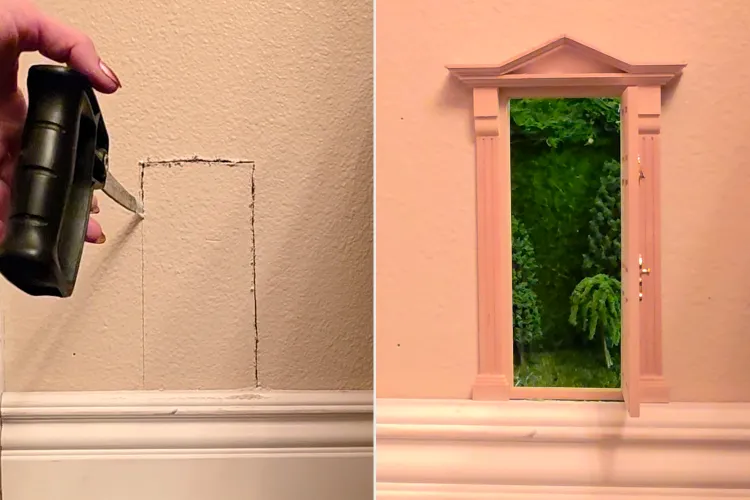
Door for the chore fairy. Credit : AzeniaVe
Credit : AzeniaVe
When her young son refused to pick up dirty socks and Lego bricks no matter how many times she asked, a mother who goes by Feb online tried something unconventional: she installed a tiny “chore fairy” door on his bedroom wall. The premise was simple. If the room was clean at bedtime, the fairy might stop by and leave a small surprise. If the room was a wreck, the fairy would skip the visit. According to Feb, the results were immediate. Her son began tidying up on his own, and she says the habit has stuck.
Feb first shared the idea in a video on social media, and it quickly resonated far beyond her own household. The clip racked up nearly 8 million views, according to a March 2026 feature in People, which reported on the story as an exclusive. By April 2026, parents across TikTok and Instagram were posting their own versions.
How the Chore Fairy Works
The concept borrows from a tradition most families already know. The tooth fairy rewards kids for something they cannot control (losing a tooth). Feb’s twist ties the reward to something they can control: cleaning up. She mounted a small decorative door low on the wall of her son’s bedroom, paired it with a backstory about a fairy who visits tidy rooms, and let his imagination do the rest.
The rewards, as Feb has described them in her posts, are deliberately small: a handwritten note from the “fairy,” a sticker, or a tiny trinket placed near the door. The scale matters. The point is not to bribe a child with expensive gifts but to give him a reason to feel proud of a clean space. Feb has said she frames the routine as helping the fairy rather than obeying a parent, a distinction that she credits with removing the power struggle from bedtime cleanup.
Why It Struck a Nerve With Parents
The video’s comment sections filled with parents describing their own failed attempts at sticker charts, chore apps, and allowance systems. Many said those tools felt transactional or lost their appeal within days. The fairy door offered something different: a physical object in the child’s own space, tied to a story rather than a spreadsheet.
That reaction lines up with what child development researchers have long observed. Dr. Laura Markham, a clinical psychologist at Columbia University and author of Peaceful Parent, Happy Child, has written extensively about how young children are more motivated by narrative and imaginative play than by abstract reward systems. A fairy door gives a preschooler something concrete to interact with, a character to “please,” and a story to participate in, all of which can make a mundane task feel meaningful.
There is a caveat, though. Psychologists who study motivation, including Edward Deci and Richard Ryan, whose self-determination theory is widely cited in parenting research, have cautioned that extrinsic rewards can sometimes undermine a child’s intrinsic motivation over time. If a child only cleans to get a trinket, the habit may not survive once the rewards stop. Feb has not addressed this directly, and it remains an open question whether the chore fairy’s magic will hold as her son gets older and more skeptical.
How Other Families Are Adapting the Idea
Since the video went viral, parents have posted dozens of variations. Some bought pre-made fairy doors from craft retailers. Others built their own from cardboard and paint. A few swapped the fairy for characters that better matched their children’s interests: a “robot inspector” for a kid who loves science fiction, a “dinosaur ranger” who checks for toy clutter, or a “pirate captain” who rewards a shipshape room.
The common thread across these adaptations is structure. The character has a visible “home” in the child’s space. The visit is tied to a specific, achievable task. And the reward stays small enough that the story, not the prize, remains the draw.
What Parents Should Keep in Mind
Feb’s chore fairy is clever, but it is not a universal fix. Its effectiveness likely depends on the child’s age (imaginative play peaks between roughly ages 3 and 7, according to the American Academy of Pediatrics), temperament, and how the parent handles the inevitable night when the room is not clean and the fairy does not visit. Consistency matters: if the rules shift or the fairy shows up regardless, the system loses credibility fast.
For families willing to commit to the bit, though, the idea offers a low-cost, low-conflict way to reframe a nightly battle. At its core, it is less a parenting hack than a storytelling trick, one that turns “clean your room” from a command into an invitation.
About the Author