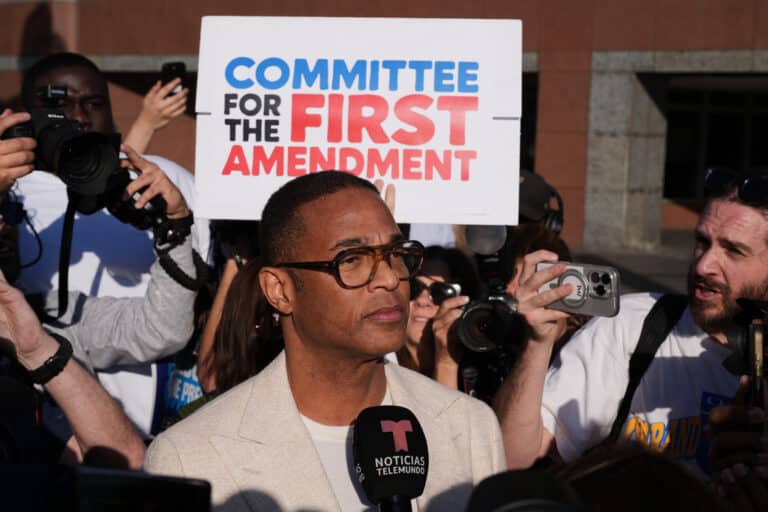
Don Lemon talks to the press after a hearing at the Edward R. Roybal Federal Building in Los Angeles on Jan. 30, 2026. AP Photo/Damian Dovarganes
Don Lemon, the former CNN prime-time anchor, is free on personal recognizance after federal agents arrested him in Beverly Hills in connection with an anti-ICE protest at a Minnesota church. But his legal battle is just beginning. Lemon faces federal civil rights charges under a statute typically used to protect access to abortion clinics, and the case has become a flashpoint in a growing national argument over press freedom, immigration enforcement, and the limits of the First Amendment.
Lemon has pleaded not guilty. His defense team says he was doing journalism. Federal prosecutors say he helped obstruct and intimidate. The outcome could set a precedent for how the government treats reporters who cover — and livestream — volatile protests in real time.
How a cable news star became a criminal defendant
For more than a decade, Don Lemon was one of the most visible faces on American cable news, anchoring CNN’s prime-time lineup until his departure from the network in 2023. After that split, he pivoted to independent media, building an audience through livestreams, YouTube, and social platforms — part of a broader wave of legacy journalists going direct to viewers.
That independent chapter is what brought him to Minnesota. According to the federal indictment, as analyzed by the First Amendment Encyclopedia at Middle Tennessee State University, Lemon traveled to cover a protest at a church that activists accused of cooperating with U.S. Immigration and Customs Enforcement. He began livestreaming as the situation escalated.
What happened at the church
The protest centered on a Minnesota church that demonstrators alleged was facilitating or cooperating with ICE operations. Activists gathered outside the building, and the confrontation grew heated enough to draw a federal law enforcement response.
Lemon was on the ground alongside other journalists and activists. According to reporting by The New York Times, he and several others were swept up together in the arrests, which is why his case is intertwined with the broader group of demonstrators rather than treated as a standalone media incident.
Prosecutors allege the protest crossed from protected speech into illegal obstruction of the church and its congregants. Supporters of the demonstrators counter that it was civil disobedience aimed squarely at immigration policy, not at religion or worship.
The indictment describes Lemon starting a livestream and narrating the scene for his audience. At one point, he allegedly commented on what he perceived as “threats of violence” at the site. Federal prosecutors now treat those remarks as part of their theory that his coverage encouraged or amplified unlawful conduct.
The charges: the FACE Act, applied to a church
The legal foundation of the case is the Freedom of Access to Clinic Entrances Act, commonly known as the FACE Act. Signed into law in 1994, the statute is best known for protecting access to reproductive health clinics. But its text also covers “places of religious worship,” prohibiting the use of force, threats of force, or physical obstruction against people exercising their religious rights or seeking religious services.
Prosecutors argue that the church protest fits squarely within that provision. As KTTC reported in its legal breakdown of the charges, the government’s theory is that the demonstrators — Lemon included — obstructed access to the church and intimidated congregants, triggering the FACE Act’s protections.
Lemon’s defense team rejects that framing. Their argument: filming a protest, narrating what you see, and criticizing a church’s alleged partnership with ICE does not constitute force, threats, or physical obstruction under any reasonable reading of the statute. They contend the government is stretching a law designed to prevent clinic blockades into a tool for punishing journalism the administration finds inconvenient.
If convicted on the conspiracy and civil rights counts in the indictment, Lemon could face federal prison time, though legal observers widely regard the charges as legally vulnerable. Brendan Hickey, a commentator affiliated with Vermont Law and Graduate School, has described the prosecution as a stress test for how courts treat reporters who become part of the story they are covering.
The arrest in Beverly Hills and release without bond
The arrest itself happened thousands of miles from Minnesota. Federal agents took Lemon into custody at a Beverly Hills hotel while he was in Los Angeles for high-profile events. Video of the arrest circulated almost immediately, turning his legal trouble into a viral moment.
Later that day, Lemon appeared before a federal magistrate judge in Los Angeles. Prosecutors from the Department of Justice argued he was a flight risk and sought travel restrictions. The judge disagreed, ordering Lemon released on personal recognizance — no bond, no jail while the case moves forward.
Outside the federal building in downtown Los Angeles, cameras captured Lemon walking out of custody and briefly addressing supporters. The image of a journalist in handcuffs one hour and free the next became the defining visual of the case’s opening chapter.
From federal custody to the Grammy Awards
The timing sharpened the story’s cultural edge. Days after the judge released him, Lemon appeared at the 2026 Grammy Awards in Los Angeles. ABC News reported that the former CNN anchor went from a Beverly Hills hotel arrest to a major awards ceremony red carpet in the same week.
The contrast split opinion online. To his supporters, the appearance was defiance — a refusal to be silenced. To critics, it looked like a celebrity treating serious federal charges as a publicity opportunity. Both reactions underscored how thoroughly the case had moved beyond the legal system and into the broader culture war.
The plea, the courtroom, and a small procedural win
Back in Minnesota, Lemon formally entered a not guilty plea to the conspiracy and civil rights counts. At the arraignment, supporters gathered outside the courthouse with signs reading “Protect the press” and chanted in support of Lemon and his co-defendants.
Inside, his lawyers pressed prosecutors to turn over more information about how the case was built. A judge granted a defense motion extending the deadline for government disclosures by 30 days — a modest but meaningful win on the procedural front, as Newsweek reported.
Defense fundraising efforts tied to the case frame it as part of a broader pattern of aggressive federal responses to protest movements. The argument from Lemon’s supporters: if a nationally known journalist can be charged under the FACE Act for livestreaming a demonstration, freelancers and local reporters covering similar events are far more exposed.
Why this case matters beyond Don Lemon
Press freedom organizations are watching closely. The indictment’s focus on Lemon’s livestream commentary — specifically his remarks about perceived “threats of violence” — raises a pointed question: can narrating a tense protest in real time be treated as incitement? If that prosecutorial theory survives, any reporter describing a crowd’s anger as it unfolds could face similar legal exposure.
The Reporters Committee for Freedom of the Press and other advocacy groups have flagged the case as a potential turning point. Their concern is not whether Lemon behaved perfectly at the protest, but whether the government’s legal theory criminalizes core journalistic activity — observing, recording, and describing events as they happen.
Federal officials counter that the FACE Act exists to protect people’s ability to worship and access services without harassment or obstruction. From the government’s perspective, the presence of a camera does not immunize someone who is helping to coordinate or amplify conduct that blocks doors or intimidates congregants.
What comes next
As of March 2026, the case remains in its early stages. The extended discovery deadline gives Lemon’s defense team more time to review the government’s evidence before the next round of motions. Legal analysts expect the defense to challenge the FACE Act’s applicability head-on, likely through a motion to dismiss that would force the court to rule on whether the statute was ever intended to reach journalists covering protests at religious sites.
A trial date has not been set. If the case does go to trial, it will be one of the first federal prosecutions to test the FACE Act’s religious-facility provisions against a First Amendment defense rooted in press freedom — a collision that legal scholars say has no clear precedent.
For Lemon, the stakes are personal and professional. For the journalists and activists watching from the sidelines, the stakes may be broader still.
About the Author