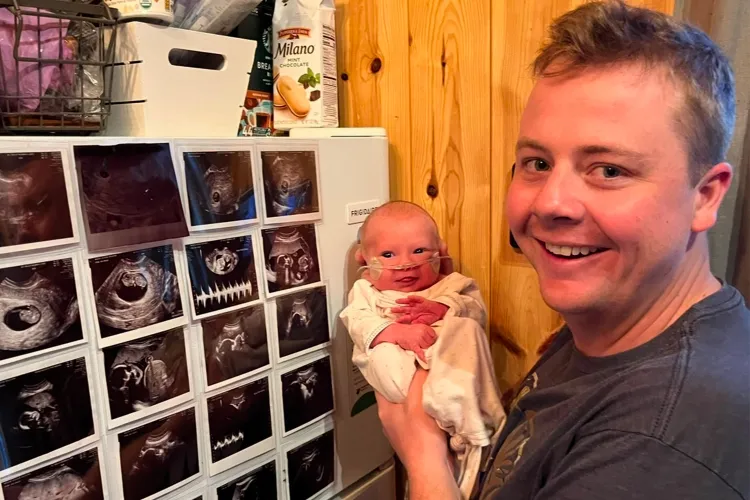
Allison Wilcox's husband, baby, and ultrasounds. Credit : Allison Wilcox
Credit : Allison Wilcox
Allison Wilcox sat through 36 ultrasounds during her 2023 pregnancy. Scan after scan, clinicians in different offices told her the same thing: the pregnancy was not viable, and she should prepare for a miscarriage. Eight months later, she delivered a healthy baby. Her story, first reported by People, is one of several cases in recent years that expose a uncomfortable truth about early pregnancy care: even the best imaging technology can get it wrong.
These cases span different hospitals, different countries, and wildly different circumstances. But they share a thread. In each one, standard diagnostic tools failed to detect or correctly assess a living pregnancy, and the families involved were left to reconcile medical certainty with outcomes no one predicted.
36 scans, one healthy baby
When Allison Wilcox, then 33, saw her first positive pregnancy test in early 2023, bleeding started almost immediately. Her medical team interpreted the early ultrasounds and bloodwork as signs of a failing pregnancy. Over the following weeks, she sought second and third opinions. Each clinician reviewed the images and reached the same conclusion.
Wilcox later told People that she never stopped holding her breath between appointments. The emotional toll was relentless: hope walking in, devastation walking out, 36 times over. But the pregnancy quietly continued. Her baby, born healthy at roughly full term, had developed normally the entire time the scans were suggesting otherwise.
Cases like hers fall under what researchers sometimes call “cryptic pregnancy,” though the term is imprecise. In Wilcox’s situation, the pregnancy was known but repeatedly misread. A 2022 review in the Journal of the Royal Society of Medicine noted that cryptic pregnancies, where the condition goes undetected until late in gestation or delivery, may occur in roughly 1 in 475 births, far more common than most clinicians assume.
A baby hidden behind a 22-pound mass
Suze Lo, a 41-year-old emergency room nurse in California, was not expecting a pregnancy at all. She had been experiencing abdominal swelling and fatigue that she and her doctors attributed to a large ovarian mass. When she arrived at Cedars-Sinai Medical Center for surgery, the plan was straightforward: remove the growth and recover.
What surgeons found was anything but straightforward. Behind a 22-pound ovarian mass, a full-term baby had been developing in her abdominal cavity, entirely outside the uterus. This is known as an abdominal ectopic pregnancy, and it is extraordinarily rare. Published estimates suggest abdominal pregnancies account for roughly 1 in 10,000 pregnancies, and the vast majority do not reach viability. A fetus surviving to term in the abdominal cavity, with a placenta attaching to organs never designed to support one, is a scenario most obstetricians will never encounter in their careers.
Lo learned she was pregnant only days before the operation. During surgery, the team delivered a healthy baby while simultaneously removing the massive cyst. The procedure turned critical when Lo experienced severe blood loss. Fox 10 Phoenix reported that she lost nearly all of her blood volume, requiring emergency transfusions. She later described the night simply: “Everything felt really fast.”
For the Cedars-Sinai surgical team, the case was the kind that reshapes how you think about what the body can do. For Lo and her family, the math was simpler. They walked into a hospital expecting to leave without a tumor. They left with a baby.
The premature baby who was declared dead
In Bradford, England, Hannah Cole faced a different version of the same dissonance between diagnosis and reality. Her son, Oakley, arrived extremely premature, so early and so fragile that the clinical team told her he had not survived. The message was direct: there would be no baby to bring home.
But Oakley was alive. Coverage from the Telegraph & Argus described how the infant, against all expectations, began showing signs of life and was transferred to neonatal intensive care. Over the following weeks, community members and strangers followed his progress as he slowly gained weight and strength.
Cole eventually brought Oakley home to Bradford after weeks of intensive care. His case raised pointed questions about how premature neonates are assessed in the moments after birth, and whether initial declarations of nonviability can sometimes be made too quickly in high-stress delivery situations.
What these cases reveal about diagnostic limits
None of these outcomes mean that ultrasounds are unreliable or that doctors routinely get it wrong. Obstetric imaging has improved dramatically over the past two decades, and the vast majority of early pregnancy assessments are accurate. But these cases, taken together, illustrate the edges of that accuracy.
Ultrasound depends on embryo position, gestational age, equipment quality, and the skill of the person reading the images. A tiny embryo implanted in an unusual location, or a pregnancy developing on an atypical timeline, can look like a nonviable pregnancy or be invisible altogether. Blood tests measuring hCG levels can suggest a failing pregnancy when levels rise more slowly than the standard curve, even if the pregnancy is progressing normally.
For patients, the practical takeaway is not to distrust their doctors but to understand that early pregnancy diagnosis involves probability, not certainty. The American College of Obstetricians and Gynecologists recommends that when initial findings are inconclusive, clinicians should schedule follow-up imaging before confirming a pregnancy loss. Patients who feel uncertain about a diagnosis have every reason to seek a second opinion or request repeat testing.
As of March 2026, Allison Wilcox’s child is a toddler. Suze Lo’s baby, born during what was supposed to be tumor-removal surgery, is thriving. Oakley Cole is a young child in Bradford. Their families know something that the scans and lab results did not: that the line between loss and life can be thinner, and stranger, than medicine sometimes accounts for.
About the Author