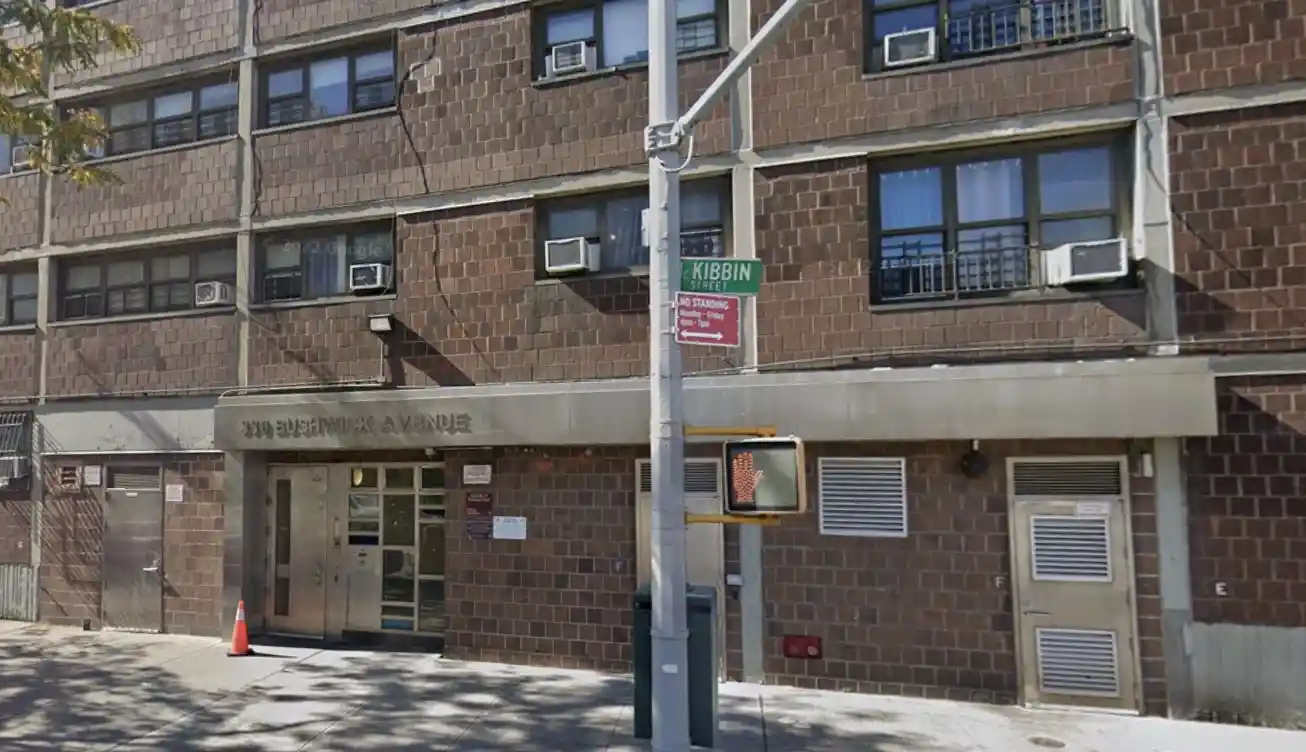
According to law enforcement sources, 39-year-old Michelle Montgomery’s remains were discovered inside a black bag inside a 330 Bushwick on Feb. 1. She was found by NYCHA workers who were cleaning up the compactor room at around 9:30 a.m. Google streetview
Google streetview
On a Sunday morning in early February 2026, a maintenance worker cleaning the basement compactor room at 330 Bushwick Avenue in Brooklyn lifted a black garbage bag and knew something was wrong. It was far too heavy. When he cut it open, he found human remains, and called 911.
The remains belonged to Michelle Montgomery, a 39-year-old mother who lived in the building, part of the Borinquen Plaza Houses, a New York City Housing Authority complex in the Williamsburg section of Brooklyn. Her body had been dismembered, and the discovery, made around 9:30 a.m., immediately turned the building into a crime scene.
In the weeks since, what initially looked like a brutal homicide has taken a turn that Montgomery’s family and neighbors are struggling to accept. Investigators now believe she may have fallen or climbed into the building’s trash chute from an upper floor and been killed by the industrial compactor in the basement, according to law enforcement sources cited by ABC7 New York. Under that theory, the dismemberment was mechanical, not the work of an attacker.
How the discovery unfolded
NYCHA workers arrived at the basement compactor room that Sunday for routine cleaning, according to amNY. The worker who found the bag attempted to load it into the compactor before realizing its weight was abnormal. After opening it and seeing what was inside, he stopped and called police.
Officers and crime scene investigators responded quickly. The New York Times reported that officials initially treated the death as suspicious, given the condition of the remains and the way they had been concealed. Montgomery was identified through personal effects and later confirmed by the medical examiner’s office.
Residents told reporters that in the hours before the discovery, they had heard screaming coming from the trash chute, a detail first reported by amNY that has become central to the investigation.
The accident theory
For the first several days, the case was treated as a probable homicide. A woman’s body, cut into pieces and left in a bag in a housing complex basement, fits a pattern investigators associate with foul play.
But as detectives reviewed surveillance footage from the building, consulted autopsy findings and examined the trash chute system, a different explanation emerged. Law enforcement sources told ABC7 New York that Montgomery is believed to have entered the chute on an upper floor, fallen to the basement and been crushed by the compactor. The injuries to her body, according to this theory, were caused by the machine rather than by a person.
As of March 2026, the NYPD has not publicly closed the investigation or issued a final determination. The medical examiner’s office has not announced an official cause and manner of death. That ambiguity has left the case in a difficult middle ground: no suspect has been named, but the accident theory has not been formally confirmed either.
Who was Michelle Montgomery
Montgomery was a mother who lived in the Borinquen Plaza complex with her husband, Anthony Echevarria, 37, according to the New York Post. The Post identified her as a mother of four, including a 19-year-old son. Echevarria has spoken publicly about his grief and his difficulty accepting what happened to his wife.
Neighbors described Montgomery as someone they recognized in the building’s hallways and common areas. Her death has unsettled the complex, where residents say they now think twice before using the trash chute.
Questions the investigation has not answered
Several significant gaps remain. Among them:
- How did Montgomery enter the chute? Trash chute openings in NYCHA buildings are typically small, designed for household garbage bags. Whether she could have fallen in accidentally, or whether the chute door on her floor was damaged or oversized, has not been publicly addressed.
- What does the surveillance footage show? Police sources have referenced video evidence in support of the accident theory, but the footage has not been released or described in detail.
- What is the official cause of death? The medical examiner’s ruling, which would distinguish between homicide, accident or undetermined, has not been made public as of March 2026.
- Has this happened before? NYCHA manages more than 2,400 buildings across New York City. Whether compactor-related deaths have occurred in other complexes is a question safety advocates have raised but that the authority has not publicly answered.
Montgomery’s family has not indicated whether they have retained legal counsel or plan to challenge the accident theory. Echevarria’s public statements have focused on his loss rather than the investigation’s direction.
A building on edge
In the weeks following the discovery, residents of the Borinquen Plaza Houses have described a building that feels different. The basement compactor room, once an unremarkable part of daily life, is now a place people avoid. The trash chute, a fixture of high-rise living in public housing, has become a source of anxiety.
NYCHA issued a brief statement after the discovery acknowledging the incident and saying it was cooperating with the NYPD investigation. The authority did not address questions about the safety of its compactor systems or whether any inspection of the equipment at 330 Bushwick Avenue had been conducted.
For the people who live in the building, the official explanation matters less right now than the fact that a woman they knew is dead, found in a garbage bag in their basement. Whether Michelle Montgomery’s death was a crime or a catastrophic accident, the result is the same: a mother of four is gone, and the place where it happened will never feel quite the same.
About the Author