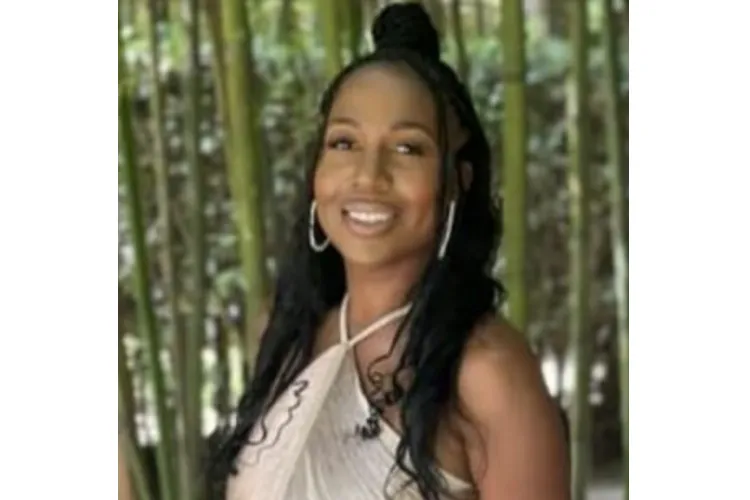
Jaqueline Durand was mauled the day before her 22nd birthday, according to a lawsuit filed in Dallas County. CBS DWF
CBS DWF
Jacqueline Durand was 21, a University of Texas at Dallas student who loved animals, when she walked into a Coppell, Texas, home to dog-sit on December 23, 2020. She left on a stretcher, her face nearly destroyed. More than five years and at least 18 reconstructive surgeries later, Durand is still healing, still visible and still talking publicly about what happened to her.
Her story is difficult to absorb. But Durand has made a deliberate choice not to disappear, and the life she is building around that choice has turned her into one of the most recognized dog-attack survivors in the country.
What happened that December afternoon
Durand had been hired through the pet-sitting app Rover to care for three dogs at the home of Justin and Ashley Bishop. According to CBS News reporting on the subsequent lawsuit, the Bishops told Durand the dogs would be crated when she arrived. A “Beware of Dog” sign was posted on the front door.
The dogs were not crated. When Durand opened the door, two of the three animals, a German Shepherd mix and a pit bull mix, attacked immediately. In interviews, Durand has said the dogs targeted her head, face and neck. She later described sustaining what she estimated were more than 800 bite wounds before a FedEx driver heard her screams and called 911.
Paramedics found her in critical condition. She was rushed to Parkland Memorial Hospital in Dallas, where trauma surgeons worked to keep her alive. A GoFundMe campaign set up by her family described the attack as nearly fatal and said she would remain hospitalized for months.
Waking up to a different life
The damage was catastrophic. Durand lost both ears, her nose, her lips and significant portions of her cheeks and lower face. She needed a feeding tube and could not speak for weeks. Relearning basic functions, swallowing, forming words, breathing through reconstructed airways, became her full-time work.
Her father, John Durand, told Spectrum News that the family had always considered themselves close, but that the crisis “took them to a different level.” Doctors laid out a surgical timeline that would stretch years into the future, with procedures to reconstruct her eyelids, nose, lips and ears in stages.
By early 2022, she had already undergone 14 surgeries. By late 2025, that number had climbed to at least 18, with more planned, according to PEOPLE magazine.
Choosing to be seen
Durand could have retreated from public life. Instead, she sat down with CBS Mornings in 2022, appearing on camera without prosthetics. “It’s time to show who I am now,” she said during the segment, a moment captured in a widely shared CBS Mornings clip.
That appearance set the tone for everything that followed. Durand began posting photos and videos documenting her surgeries, her physical therapy and the small victories: eating at a restaurant, laughing with friends, going outside without a mask. She did not frame herself as an inspiration. She simply let people see what recovery from a disfiguring attack actually looks like, day by day.
The openness resonated. Viewers who had never considered the realities of facial reconstruction or the long-term consequences of dog aggression suddenly had a person, not a headline, to connect those subjects to.
The $39 million verdict
Durand’s family filed a lawsuit against Justin and Ashley Bishop, alleging the couple knew their dogs were dangerous and failed to secure them as promised. Court filings cited the warning sign on the door and the broken promise about crating as evidence the Bishops were aware of the risk, according to CBS News.
In 2023, a Dallas County jury sided with Durand and awarded her approximately $39 million in damages, one of the largest dog-attack verdicts in Texas history. The two dogs that attacked her were euthanized. The Bishops’ attorneys had argued the couple did not anticipate the level of aggression, but jurors found the owners liable.
The financial reality behind the verdict remains complicated. Dozens of surgeries, years of hospitalization and ongoing therapy have generated enormous medical costs, and collecting a civil judgment of that size is rarely straightforward. Durand’s family has acknowledged the strain but has consistently returned to the same point in interviews: they are grateful she survived at all.
Five years later: where Durand stands now
In late 2025, Durand marked the anniversary of the attack with a new video and updated photos. She was candid about what remains hard: scar tissue that still tightens, future operations that have not yet been scheduled, the psychological weight of living in a face that strangers stare at.
But she was equally direct about what has changed. “Not that I would ever say that I wanted to go through this,” she told Stuff.co.nz. “But I will say I am stronger than I have ever been mentally.”
As of March 2026, Durand continues to share updates across social media, including longer-form podcast interviews where she walks through the attack, her recovery and her evolving perspective on survival. Her following has grown into a community of other trauma survivors, dog-bite victims and people drawn to her refusal to minimize what happened or hide from it.
She has not announced a formal career pivot into advocacy, but the role has found her anyway. Every post, every interview, every photo she shares without apology functions as a quiet argument: that surviving something terrible does not require pretending it was not terrible, and that being seen, fully and honestly, is its own kind of defiance.
About the Author