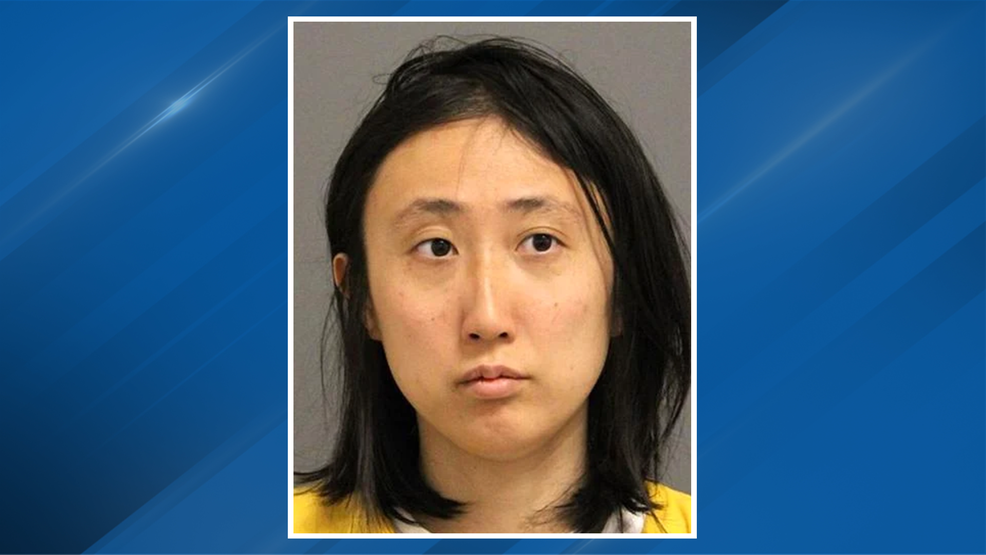
Shenting Guo (Photo courtesy of Mesa County Detention Center)
Shenting Guo, 32, has been charged with second-degree murder in Grand Junction, Colorado, after police say she stabbed her partner to death and mutilated his genitals during a domestic dispute. The Mesa County case, which came to light in early 2025, has drawn national attention for the severity of the injuries described in charging documents and the volatile circumstances investigators say preceded the killing.
Guo remains in custody at the Mesa County Detention Facility. As of April 2026, court records do not reflect a plea, and it is unclear whether her defense attorney has made any public statement about the charges.
What charging documents describe
According to the criminal complaint filed in Mesa County District Court, officers responded to a residence in Grand Junction and found a man dead from multiple stab wounds. The document identifies the suspect as Guo and states that the victim’s groin area had been severely cut in what officers characterized as mutilation. One responding officer described the scene as “crazy” and “gross,” language included in the complaint and reported by ABC7.
Prosecutors allege that Guo attacked the victim with a knife during an argument, stabbing him multiple times. The mutilation, according to the complaint, occurred while the victim was incapacitated or dying. Investigators say Guo did not flee and was still inside the residence when officers arrived.
Suspected motive: infidelity and pregnancy
During police questioning, Guo told investigators she believed her partner had been unfaithful, according to the charging documents. She also told officers she was pregnant at the time of the killing, a claim that has not been independently confirmed in public court filings.
Guo reportedly referenced painkillers during the interview, though the complaint does not specify whether she said she had taken them herself or whether they were connected to the victim. Investigators noted in the complaint that the couple’s relationship had been marked by escalating arguments, with jealousy and accusations of cheating at the center of recent conflicts, as KOMO News reported.
Why second-degree murder, not first-degree
Under Colorado law, first-degree murder requires proof that the killing was deliberate and premeditated. Second-degree murder, codified in C.R.S. 18-3-103, applies when a person knowingly causes the death of another but without the advance planning element. It carries a mandatory sentence range of 16 to 48 years in Colorado.
The distinction matters here. Prosecutors appear to be treating the killing as an act that grew out of a volatile argument rather than a preconceived plan. But the alleged mutilation could cut both ways at trial. A jury might interpret it as evidence of extreme rage in the moment, or as a calculated act of degradation that suggests deeper intent. How the defense frames Guo’s mental and emotional state during the attack will likely be central to the case.
Genital mutilation in domestic homicides: rare but not unprecedented
The targeting of a victim’s genitals in a domestic killing is uncommon, but it has surfaced in a handful of high-profile cases over the decades. Forensic psychiatrists who study intimate partner homicide have noted that genital injuries in these contexts often correlate with sexual jealousy or a desire to punish a partner for perceived betrayal.
Dr. Michael Welner, a forensic psychiatrist who has consulted on domestic homicide cases, has written that mutilation after a killing can reflect “personalized rage” directed at the specific source of the attacker’s grievance. In cases involving suspected infidelity, that rage is sometimes directed at the victim’s sexual anatomy.
One of the most widely cited examples is the 1991 case of Omaima Nelson in Orange County, California. Nelson killed her husband, William Nelson, then dismembered and castrated his body. She was convicted of second-degree murder in 1993. Court records and Los Angeles Times reporting from the trial documented that Nelson claimed her husband had abused her, though prosecutors argued the killing was driven by financial motives. The case remains a reference point in discussions of extreme domestic violence.
The broader pattern: escalation before lethal violence
Domestic violence researchers have long identified a pattern in which verbal threats and escalating conflict precede fatal attacks. According to the National Domestic Violence Hotline, a history of increasingly severe arguments is one of the strongest predictors of lethal violence between intimate partners.
The Guo case fits that pattern, at least as prosecutors describe it. The charging documents reference a relationship that had been deteriorating, with arguments growing more intense in the period before the killing. Whether Guo made specific threats before the fatal confrontation has not been detailed in public filings.
In a separate and unrelated case in Minnesota, prosecutors charged a 23-year-old woman with fatally stabbing her boyfriend after an argument. According to Bring Me The News, charging documents allege the woman had told a coworker she “could kill somebody” before the stabbing occurred. That case, while factually distinct from Guo’s, illustrates how prior statements can become pivotal evidence when prosecutors build a narrative of intent.
What comes next in the Guo case
Guo’s case is expected to move through preliminary hearings in Mesa County District Court in the coming months. Key questions that remain unanswered include whether her defense will raise a claim of self-defense or diminished capacity, whether the pregnancy claim will be substantiated, and whether additional charges could be filed as the investigation continues.
The victim’s identity has appeared in some local reports, but his family has not made public statements. The Mesa County District Attorney’s office has not commented beyond the charges filed.
If you or someone you know is experiencing domestic violence, the National Domestic Violence Hotline is available 24/7 at 1-800-799-7233 or by texting START to 88788.
About the Author