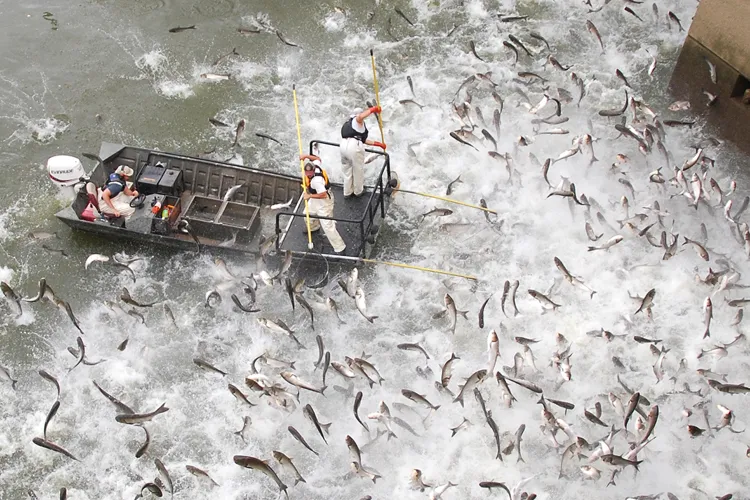
Silver carp jump from the water at Barkley Dam in Kentucky, where an experiment with acoustic technology and a bubble curtain is occurring. Credit : Kristen Peters/USFWS
Credit : Kristen Peters/USFWS
The Kansas River has just gone through a massive cleanup, and the numbers are hard to ignore. Wildlife crews have hauled out more than 100,000 pounds of invasive carp from a single river system, turning a quiet Midwestern waterway into one of the country’s most ambitious freshwater restoration stories. The work is gritty, loud, and occasionally chaotic, but it is already reshaping life beneath the surface for native fish and the people who depend on this river.
Since removal efforts began in 2022, Kansas biologists have steadily scaled up their campaign, using boats, nets, and electricity to stun and scoop out fish that never should have been there in the first place. By the end of 2025, the tally had climbed to about 109,000 pounds of invasive carp, a figure that signals both the scale of the problem and the determination to fix it.
The jaw-dropping haul on the Kansas River
The basic headline number is staggering: Kansas biologists have removed about 109,000 pounds of invasive carp from the Kansas River since the campaign began. Wildlife experts in Kansas describe the haul as part of a broader push to protect native river life, with more than 100,000 Pounds of unwanted fish now out of the system. Local coverage from KSNT notes that Biologists have already destroyed over 100,000 pounds of invasive fish in the Kansas River alone, much of it near TOPEKA in Kansas.
The work is not just about hitting a big round number. Crews are targeting three aggressive invaders, including Silver carp that can rocket out of the water as boats pass. Some of these fish can reach sizes that rival a medium dog, with individuals exceeding 100 pounds, according to One River coverage of the campaign. Wildlife experts describe the broader push as an effort to Save Native River, with Pounds of Invasive now topping 100,000 across the project. For residents who fish or paddle the river, that translates into fewer leaping carp and a better shot at seeing native species rebound.
How the removal works and why it matters
On the water, the operation looks more like a construction site than a quiet day of field biology. Removal efforts rely on boats rigged with metal booms and cables that send electric currents into the water, briefly stunning fish so they float to the surface. Biologists with the Kansas Department of then scoop the carp into holding tanks as the boat moves forward, a process that Cheryl Santa, a digital Journalist, has described as a kind of moving assembly line on the river. The agency capped off 2025 with its most productive season yet, turning the Kansas River into a test case for how far targeted removal can go.
The numbers behind that record year help explain the momentum. Over 36,000 pounds of invasive carp were pulled in 2025 alone, the Kansas River’s best year for invasive removal since efforts began in 2022. Coverage of the project notes that Over time, that kind of sustained pressure can tilt the balance back toward native species that have been crowded out. Wildlife experts say the goal is to Save Native River by cutting down on carp that can eat up to a third of their bodyweight every day, a feeding habit highlighted in reporting on Workers on the river.
From “harmful creatures” to healthier rivers
For people who live along the Kansas River, the carp problem has never been abstract. These fish churn up sediment, cloud the water, and compete with native species that anglers actually want to catch. Coverage of the cleanup describes 100,000 pounds of “harmful creatures” being removed, with early reports of Positive effects on water quality and native fish behavior. Another account of the effort to Save Native River notes that Wildlife experts in Kansas see the project as a long game, with each season’s haul building on the last.
The ripple effects reach beyond ecology into culture and recreation. A separate report on a record 64-pound catch in the state points readers to the Department of Wildlife records, a reminder that anglers track these waters closely and care about what swims in them. When Media Error briefly interrupted one video report on the carp removal, it was a small glitch in a story that has otherwise been remarkably consistent: take out the invaders, and the river starts to bounce back.
Officials and reporters alike have leaned on vivid language to capture the scale of the work. One account describes Workers removing a “jaw-dropping” 100,000 pounds of carp, while another notes that wildlife experts in Kansas have now pulled Over Pounds of Invasive that easily clear the 100,000 Pounds mark. For a single river, that is a lot of biomass, and a lot of room for native fish to reclaim their home.
About the Author