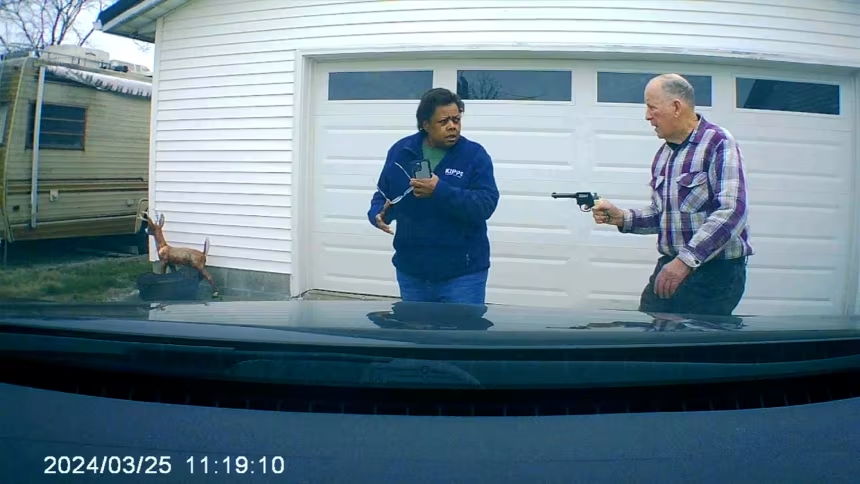
William Brock holds a weapon to Uber driver Lo-Letha Hall outside his home in South Charleston, Ohio, in March 2024, in this image taken from Uber dashcam video. (The Clark County Sheriff’s Office)
An elderly Ohio homeowner who opened fire on an Uber driver in his driveway, convinced she was part of a phone scam, will likely spend the rest of his life in prison. The killing of 61-year-old Lo-Letha Toland-Hall, who was simply trying to complete a ride request, has become a stark example of how fear, misinformation, and firearms can collide in a single tragic moment.
Now, at 83, William Brock has been sentenced to 21 years to life for murder, a punishment that reflects both the brutality of the shooting and the court’s rejection of his claim that he was acting in self-defense. The case has rattled ride-share drivers and older residents alike, exposing how easily a scammer’s call can turn a quiet afternoon into a fatal misunderstanding.
From Scam Call To Deadly Encounter
The chain of events started not with a knock on the door, but with a barrage of phone calls. Prosecutors said Brock, an 83-year-old man in Clark County, Ohio, was targeted by scammers who convinced him that a loved one was in legal trouble and that cash needed to be picked up at his home. Instead of showing up themselves, the scammers used a ride-hailing app to send an unsuspecting driver to his address, turning the Uber platform into a delivery service for their scheme. By the time Lo-Letha Toland-Hall pulled into his driveway, Brock was primed to see anyone who arrived as a threat.
Toland-Hall, a 61-y driver working for Uber, believed she was picking up a routine assignment, not walking into a standoff with an armed homeowner. According to investigators, she followed the instructions sent through the app, drove to the rural property, and ended up face to face with a man who had already decided that whoever came to his door was part of a criminal plot. That assumption, built on nothing more than a series of fraudulent calls, set the stage for a confrontation that escalated in seconds and left Toland-Hall fatally wounded in the driveway.
The Shooting And The Story Brock Told
What happened in those final moments became the heart of the trial. Brock claimed he believed Toland-Hall was there to rob him, insisting he fired because he feared for his life. But jurors heard that the driver had no weapon, no history with Brock, and no idea she had been pulled into a scam. A jury in Ohio ultimately rejected his self-defense narrative, finding that his decision to confront and then shoot the driver crossed the line from fear into criminal violence.
Witness accounts and physical evidence painted a picture of Toland-Hall trying to do her job while Brock escalated the encounter. Reporting on the case noted that he fired multiple shots, striking the 61-y driver and leaving her to die at the scene. The fact that she had been dispatched by scammers did not change the reality that she was an innocent third party, a working woman caught between a con artist’s script and a homeowner’s gun. For jurors, the key question was not whether Brock had been targeted by fraudsters, but whether his response to a stranger in his driveway was reasonable. Their guilty verdict on murder made clear that they believed it was not.
Conviction Of An 83-Year-Old And A Family’s Loss
The verdict landed with particular weight because of Brock’s age. An 83-year-old defendant is not what most people picture when they think of a murder trial, and his lawyers leaned into that, portraying him as a frightened senior overwhelmed by a sophisticated scam. But the jury’s decision underscored that age alone does not excuse pulling the trigger on an unarmed stranger. The panel concluded that Brock’s fear, however real, did not justify the deadly force he used on a driver who never posed a lethal threat.
For Toland-Hall’s loved ones, the focus was never on the defendant’s birth year, but on the life that was taken. Relatives described the 61-y Uber driver as a hardworking woman who was simply trying to support herself when she accepted the ride request that led her to Brock’s home. In victim impact statements referenced in local coverage, family members spoke about birthdays and holidays that will now pass with an empty chair, and about the cruel irony that a scam aimed at easy money ended with a mother and friend dead. Their grief framed the trial not as a story about an elderly man’s mistake, but as a story about a family robbed of someone they expected to come home from work.
Sentencing: 21 Years To Life For William Brock
Once the guilty verdict was in, the question shifted to how much time Brock would actually serve. In a Clark County courtroom, a judge sentenced William Brock, 83, to a combined 21 years to life in prison for the murder of Toland-Hall and related firearm charges. The structure of the sentence means he will not even be eligible for parole until he is well past 100, making it effectively a life term. The judge emphasized that the punishment reflected both the seriousness of taking a life and the need to send a message that misreading a situation does not give anyone a license to kill.
Coverage of the hearing noted that the sentence included a mandatory firearm specification attached to the murder offense, which added years on top of the base term for the killing itself, as detailed in sentencing records. Another report described how the judge formally imposed 21 years to life after reviewing Brock’s age, his lack of prior violent convictions, and the devastating impact on Toland-Hall’s family, confirming that the court saw no justification for a lighter outcome in light of the facts presented at trial, as reflected in local coverage.
How A Scam Turned Deadly For An Uber Driver
Beyond the courtroom, the case has become a cautionary tale about how modern scams can spill into real-world danger. The fraudsters who targeted Brock never had to step foot on his property. Instead, they used a ride-hailing app to send Toland-Hall to his home, effectively outsourcing the riskiest part of their scheme to an unsuspecting worker. Reporting on the case has detailed how the scammers arranged for the driver to pick up a package of cash, a tactic that has been seen in other phone frauds where criminals pose as law enforcement or court officials and demand immediate payment, as described in court summaries.
For ride-share drivers, the story hits especially hard because it highlights a risk they cannot easily see coming. Toland-Hall accepted a job through the Uber app, followed the GPS directions, and tried to complete the task she had been given. She had no way of knowing that the person waiting for her believed he was under attack. One account of the sentencing described the case as a “UBER DRIVER MURDER” in BREAKING NEWS coverage, capturing the shock that a routine trip could end in gunfire. Another report on the sentencing of the 83-year-old Ohio man noted that Toland-Hall’s death has sparked fresh conversations about how companies like Uber should warn drivers about suspicious pickups and how law enforcement can better educate older residents about scam tactics.
About the Author