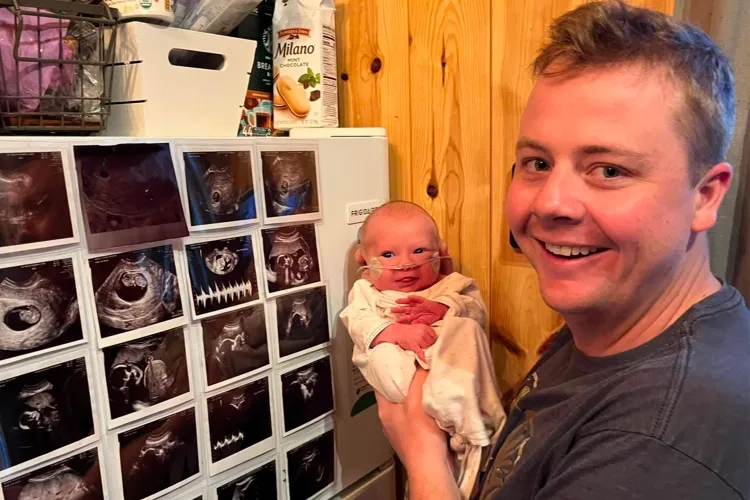
Allison Wilcox's husband, baby, and ultrasounds. Credit : Allison Wilcox
Credit : Allison Wilcox
Doctors told Allison Wilcox that her pregnancy was over before it had really begun. They warned her to brace for loss, then watched her numbers and scans as if they were tracking a tragedy in slow motion. Instead, months later, she was holding a healthy newborn that even her medical team struggled to explain.
Her story, and a wave of similarly improbable births, has turned the phrase “miracle baby” from cliché into clinical head-scratcher. From pregnancies hidden behind massive tumors to surprise deliveries on Christmas, these cases are forcing doctors and parents alike to rethink what is possible when medicine, timing and sheer luck collide.
The night everything was supposed to be over
Allison Wilcox’s ordeal started almost as soon as she saw a positive test. The day after she learned she was pregnant, she began bleeding so heavily that she and her husband rushed to the emergency room, convinced something was terribly wrong. In that first visit, she recalls an ER doctor bluntly telling her that “at this point, miscarriage is the best outcome,” a line that lodged in her memory as the staff prepared her to say goodbye to a baby they believed she would never meet, a scene later detailed in reporting on her pregnancy.
Over the next several days, the news only seemed to get worse. Ultrasounds failed to show a clear heartbeat, bloodwork did not behave the way clinicians expected, and specialists repeated the same verdict: she was, in their view, losing the pregnancy. At one point, Allison was told there was no viable embryo and that her body would likely complete the miscarriage on its own, a conclusion that left husband heartbroken as they drove home from the hospital.
Thirty-six scans, eight months of doubt and one healthy newborn
What followed was less a typical pregnancy than a medical marathon. Because her symptoms and early imaging were so confusing, Allison cycled through appointment after appointment, trying to answer the same basic question: was there still a baby, or just lingering hormones from a loss that had already happened. By the time she delivered, she had undergone 36 separate ultrasound exams, each one a fresh mix of hope and dread as technicians searched for signs of life.
Eight months after those first terrifying days, the story took a turn no one had predicted. Instead of scheduling a procedure to clear what some doctors still believed was nonviable tissue, Allison went into labor and delivered a living, breathing child that her care team openly described as a miracle. Later coverage of the case noted how, earlier in the pregnancy, Believing she had already miscarried, Wilcox and her husband had even arrived at a hospital that was on lockdown, a surreal backdrop to what they thought would be the end of their journey.
Specialists who later reviewed her chart pointed to the limits of early imaging and the messy reality of first-trimester bleeding, especially in pregnancies that do not follow textbook patterns. In interviews, Allison Wilcox has described the emotional whiplash of being told, repeatedly, that the pregnancy was over, only to watch new scans hint at a different outcome. A separate account of the same saga, focused on how Allison Wilcox and her husband navigated those months, underscored how fragile their hope felt right up until they heard their baby cry.
Other “how is this possible” pregnancies
Allison’s story is striking, but it is landing in a moment when other families are hearing similar words from their doctors: “medical miracle.” In California, Suze Lopez checked into Cedar Sinai for surgery to remove what she had been told was a more than 20 pound ovarian cyst. Surgeons expected a grueling operation, not a delivery, yet during the procedure they discovered a viable fetus developing outside the uterus and managed to remove a 22 pound tumor while also safely delivering a Baby that colleagues later described as one of the rarest outcomes they had ever seen.
Video shared from the operating room’s aftermath captured staff at Cedar Sinai marveling at what had just happened, with one segment referring to the case as a “medical marvel” and highlighting how close both mother and child came to a very different ending. A local station in Bakersfield later reported that Suze Lopez had only learned she was pregnant days before, after taking a routine test ahead of surgery, and that Dec coverage of the case described how She shared the news with her husband at a Dodgers game, a moment later immortalized in a PHOTO that circulated widely.
Another family in California learned they were expecting only after doctors discovered that a massive 22 pound cyst had been hiding their pregnancy on scans. In that case, the Baby was literally tucked behind the growth, shielded from view until surgeons went in to remove the mass and found a heartbeat. Social media clips from the hospital, including one shared by There on a local account with 97 likes, framed the outcome as a holiday-season miracle for a family that had braced for cancer, not a newborn.
Christmas babies that no one saw coming
Not every surprise pregnancy involves a tumor or a high-risk surgery. In the Chicago suburbs, a woman walked into an emergency room on Christmas with what she thought was severe stomach pain and walked out with a newborn. Local TV described it as a “Christmas miracle,” airing footage of the new mother cradling her son and admitting she had no idea she was pregnant until doctors told her she was in active labor, a story captured in a segment that opened with the anchor saying it was one of those tales that makes you pause and think How this could happen.
National outlets later identified the mother as Melanie Smith, a 28-year-old from Zion, Illinois, who said she had chalked up her symptoms to holiday stress and a bad meal. In one interview, Melanie said she “couldn’t imagine life without him anymore,” even though she had met him only hours earlier. Another write-up, by reporter Clare Fisher, noted that NBC and Chicago viewers were introduced to the story under a NEED TO KNOW banner that underscored just how rare it is for someone to reach full term without realizing they are pregnant.
What these “miracle” stories reveal about medicine and hope
For doctors, cases like Allison Wilcox’s are humbling reminders that even the best tools have blind spots. Early in her pregnancy, multiple clinicians looked at the same bleeding, the same lab values and the same grainy images and concluded that miscarriage was inevitable, or had already happened. Later coverage of her ordeal emphasized how Despite those warnings, she kept asking for repeat scans and second opinions, a persistence that may have been the difference between scheduling a procedure and discovering a heartbeat.
At the same time, physicians who worked on the Lopez case and the hidden-cyst pregnancy have been careful to stress that these outcomes are the exception, not the rule. In their view, calling a baby a miracle is less about abandoning science and more about acknowledging how many things had to go exactly right for mother and child to survive. That nuance can get lost in viral clips and breathless social posts, but it is there in the detailed write-ups of Allison’s journey and in the local reporting that followed Suze Lopez home from the hospital.
For parents, though, the language is simpler. Whether they are watching monitors in an operating room, clutching a partner’s hand in a locked-down ER, or walking into urgent care on Christmas thinking they have food poisoning, the only thing that matters in the end is the baby in their arms. In that sense, the label “miracle” is less a medical verdict than a shorthand for surviving the worst night of their lives and getting an ending they had been told to stop hoping for.
About the Author