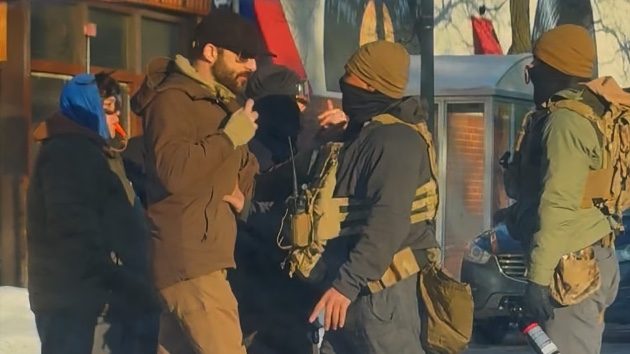
Three minutes and two seconds before the first shot is fired, Alex Pretti holds a phone before a federal officer on Nicollet Ave in Minnesota. Obtained by (ABC News)
The newly released timeline of the killing of Alex Jeffrey Pretti, paired with frame-by-frame video analysis, strips away the abstractions that usually surround police shootings and replaces them with seconds, angles and choices. Instead of a hazy clash between “agents” and a “suspect,” the public now sees a 37-year-old intensive care nurse pinned on Minneapolis pavement while federal officers close in and open fire. The breakdown of those agents’ actions is already reshaping how the country talks about force, accountability and the risks of aggressive immigration enforcement in American cities.
What emerges from the synced clips and investigative reports is not a single shocking moment, but a chain of decisions that built toward a fatal outcome. From the first contact on the street to the final volley of shots, the record now shows who moved where, who said what and how quickly the situation spun from tense to lethal.
The minute‑by‑minute breakdown on the street
Investigators have now stitched together a detailed clock of the encounter, using at least Three verified civilian and surveillance videos to map the final minutes of Alex Jeffrey Pretti’s life. Federal agents shot and killed the 37-year-old Minneapolis resident, identified as Alex Jeffrey Pretti, at about 9 a.m. Central on a Saturday, after he approached an immigration arrest operation with his phone raised and started recording the scene, according to a reconstructed timeline. Earlier this year, a separate visual analysis showed that roughly 58 seconds before the first shot, Pretti was still standing several feet away from the agents, not physically engaged, while one officer focused on a woman already being detained, a sequence later echoed in a graphic video analysis.
As the confrontation escalated, the clock becomes brutally precise. One reconstruction based on five verified clips notes that at 8:58:11 a.m., roughly Three minutes before the gunfire, agents first pushed Pretti toward the ground, starting a struggle that drew shouts from nearby observers, according to a granular breakdown. By 9:01:05 a.m., a woman can be heard yelling that officers are “kicking” an observer as one agent appears to draw a handgun, a moment captured in another synchronized timeline. At 9:01:13 a.m., Three different cameras record the instant shots are fired, and by 9:01:14 a.m., at least One officer has already stepped back from Pretti’s body, a detail that also appears in a separate second‑by‑second account.
What the videos show about the agents’ decisions
The raw timing is only part of the story; the angles and body positions in those clips are what have fueled outrage. A detailed visual reconstruction shows that at the moment shots were fired, Pretti was already on the ground, apparently unarmed, with at least two agents standing over him, according to a forensic video analysis. Another investigation into how two federal agents escalated the encounter concludes that the officers repeatedly closed distance on Pretti instead of backing off, even after he was prone, and then fired while he was on the ground, unarmed, a pattern described in a narrative of how the situation turned deadly. A separate interactive timeline notes that Federal agents later claimed they believed Pretti intended to “massacre” them, even as the synced footage shows him surrounded and outnumbered, a contrast highlighted in another reconstruction.
Those visuals have also undercut early official claims about weapons and threats. A Department of Homeland Security internal investigation, summarized in a report to Congress, found that 2 agents fired their weapons and did not document any moment when Pretti brandished a gun, according to a detailed shooting probe. Another account of that DHS review notes explicitly that the report does not mention Pretti pointing a firearm at agents at any time, even as it confirms that the officers who fired have been placed on leave, a gap laid out in a separate follow‑up. That disconnect between the visual record and the initial narrative is a big reason the minute‑by‑minute breakdown has landed with such force.
Context, prior encounters and the political fallout
The shooting did not happen in a vacuum, and the new timeline has pulled earlier encounters into sharper focus. Days before his death, Unearthed clips from Minneapolis show Alex Pretti being taken to the ground by federal immigration agents, who pin him, tell him to let go and then release him as he scurries away, according to newly surfaced video. A second version of that report, framed as a Nation Jan dispatch from WASHINGTON, again describes Alex Pretti being forced down by officers and then allowed to leave, underscoring that agents already knew who he was before the fatal encounter, as detailed in a companion account. That history now sits alongside the core facts of the Killing of Alex Pretti, in which On January 24, 2026, Alex Jeffrey Pretti, a 37-year-old American intensive care nurse for the United Stat, was shot and killed by federal agents in Minneapolis while holding his phone and with his arm around the woman they were arresting, a summary captured in the entry on the Killing of Alex.
About the Author