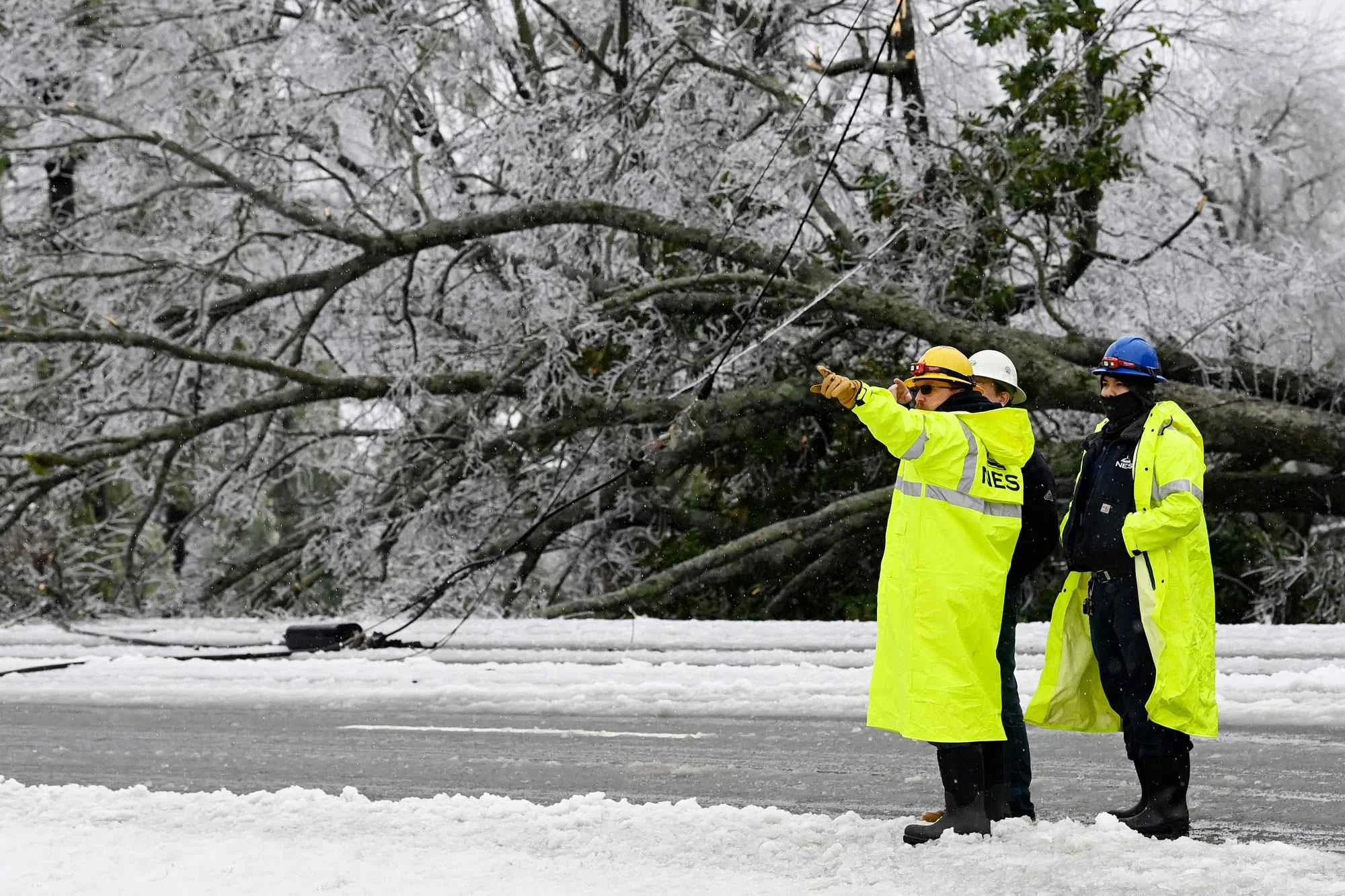
MARK ZALESKI/THE TENNESSEAN/USA TODAY NETWORK via Imagn Images First responders assess a downed power line in Nashville, Tenn. on Jan. 25.
First responders assess a downed power line in Nashville, Tenn. on Jan. 25.
The latest winter blast to sweep the United States has turned deadly, with at least nine people killed and roughly 800,000 customers losing power at the height of the outages. Among the dead is an elementary school teacher who was found in the snow after trying to navigate the brutal conditions. The storm, part of a larger North American system, has piled on deep snow, dangerous ice and life threatening cold from the southern Plains to New England.
What began as another rough winter weekend quickly escalated into a crisis that exposed just how fragile daily routines become when the lights go out and the temperature plunges. Families have been left grieving, communities are scrambling to restore basic services, and officials are warning that in some parts of the South, the recovery will be measured in weeks, not days.
The human toll behind the numbers
Officials say the immediate death count tied to this latest wave of severe weather has climbed to at least nine, a figure that captures only a slice of the wider catastrophe unfolding across the country. According to a NEED TO KNOW briefing, those nine deaths are directly linked to the winter storm that slammed the U.S. late last week into the weekend, with victims succumbing to crashes, exposure and medical emergencies made worse by the cold. That local snapshot sits inside a much larger national picture, as a separate tally of the broader January outbreak of snow and Arctic air has pushed the combined winter storm and cold related death toll to more than 30, according to a Death analysis.
One of the most wrenching stories to emerge from this latest surge of bad weather comes from Kansas, where a local educator never made it home. A Kansas elementary school teacher was found dead in the snow amid Winter Storm Fern, after a K9 officer located the body, a reminder that behind every statistic is a classroom of students and a circle of friends suddenly left without the person they counted on.
Power outages, frozen roads and a region on edge
Alongside the deaths, the storm’s most visible legacy has been the sea of darkened neighborhoods stretching across the map. At the peak of the chaos, roughly 800,000 customers were left Without Power as heavy, wet snow and thick glaze ice snapped lines and toppled trees. In parts of the South, utilities are warning that some communities could be in the dark for “weeks, not days,” a blunt assessment that tracks with a broader South wide review of the damage. Power officials in Nashville have already told residents to brace for lengthy outages from what they describe as a historic storm, while Mississippi Gov Tate Reeves has deployed additional resources to keep people warm and roads passable.
The misery has been spread out but not evenly. The Tennessee Department of Health has raised the statewide death toll linked to Winter Storm Winter Storm Fern to 14, while about 90,000 people in the Nashville area are still without electricity as crews work through downed lines and blocked streets. In Texas, the cold has been just as unforgiving, with Three boys in Texas dying after falling into an icy pond as temperatures plunged to about minus 32C late Monday into Tuesday, according to the Guardian. Those tragedies are playing out while hundreds of thousands of people remain in the dark, a situation that one national overview described as Hundreds of thousands still without power on Monday evening.
A sprawling, historic system stretching across the map
What residents are living through on the ground is part of a much bigger atmospheric event that has sprawled across the continent. Meteorologists identify this as the January 2026 North American winter storm, a system so large that GOES satellite imagery has captured its swirl from the Pacific to the Atlantic, with multiple regions in the South breaking daily snowfall records. Over the weekend, a large portion of the United States was hit by severe snow, power outages and travel chaos, as one national briefing put it, with officials admitting that even seasoned forecasters were not fully prepared for the scale of what arrived. Live coverage of the What we covered updates has described deadly cold, at least 12 people dying in the coldest temperatures of the winter and tens of millions under winter alerts.
On the ground, the storm has been given the name Winter Storm Winter Storm Fern, and its footprint is enormous. A significant band of snow, ice and mixed precipitation has stretched from the southern Plains to New England, with the Northeast taking the final hit of snowfall even as the South digs out. One live update feed noted that The Northeast is now seeing the last of Fern’s snow, but the impacts will linger for millions. Another national recap framed it bluntly, saying that Over the weekend the storm led to more than 30 deaths across the country. A separate overview of the same system described how Monday still found hundreds of thousands without power, while a running log of Power outages warned that some parts of the grid were so damaged that full restoration would be slow.
About the Author