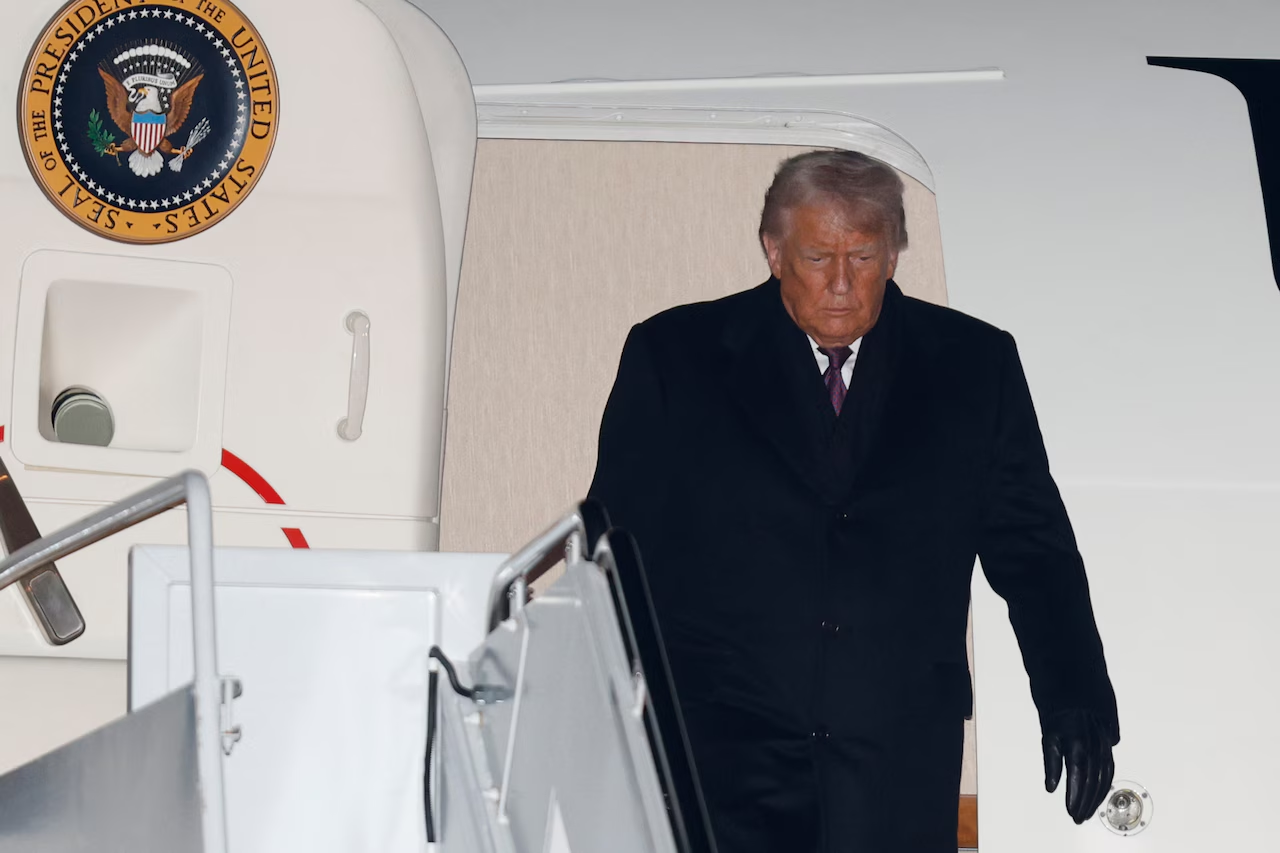
President Donald Trump arrives on Air Force One at Joint Base Andrews, Md., Thursday, Jan. 22, 2026, after returning from the World Economic Forum in Davos.(AP Photo/Luis M. Alvarez)AP
President Donald Trump’s latest attempt to quiet questions about his health did the opposite, turning into a viral moment when he appeared to grope for the word “Alzheimer’s” while talking about his father’s illness. In a conversation meant to project strength and reassure voters, he instead pointed to his forehead, paused, and asked out loud, “What do they call it,” before finally landing on the diagnosis. The stumble, paired with his insistence that he does not have the disease, has reignited a debate that has been simmering around his public appearances for months.
The exchange was brief, but it hit a nerve. Trump framed his father’s condition as “one problem” late in life, then used that story to argue that he himself is mentally sharp and unfairly targeted. Yet the hesitation over such a familiar word, especially in a high-stakes health interview, gave critics fresh ammunition and left allies scrambling to cast the moment as harmless.
The awkward pause that lit up the health debate
The key moment came when Trump, describing his father’s decline, said that “[My father] had one problem” and then trailed off, tapping his forehead as he searched for the name of the disease. According to one account, he looked to his interviewer for help and asked, “what do they call it,” before finally identifying it as Alzheimer’s and moving on to insist that he does not share that diagnosis. The hesitation, captured on video and replayed endlessly, turned what could have been a sympathetic family anecdote into a clip that many viewers read as a real-time lapse, even as allies argued it was simply a common pause in unscripted speech that happened while he was talking about a CT scan.
Trump’s own framing did not help him. He used the story of his father’s Alzheimer’s to draw a sharp line between their conditions, stressing that he does not have the disease and that his doctors have cleared him. Yet in the same breath, he appeared to forget the name of the illness, a disconnect that critics seized on as symbolic of a larger pattern. The moment echoed other recent appearances in which he has tried to project vigor while brushing off concerns about his age and cognition, only to have a stray phrase or visible hesitation dominate the conversation. For a president who has long sold himself as uniquely energetic, the image of him searching for the word “Alzheimer’s” while insisting “I don’t have it” was always going to land awkwardly.
Trump’s insistence on fitness collides with the optics
Trump has been trying to get ahead of health questions by leaning into them, talking about tests, scans, and his daily routine as proof that he is fit for the job. In this interview, he again stressed that he had undergone evaluations and that doctors had not found signs of cognitive decline, using his father’s history as a contrast point. Yet the way he told the story, pausing on the name of the disease and then quickly pivoting to a denial, undercut the message he was trying to send. One detailed account of the exchange noted that he struggled to come up with “Alzheimer’s” to describe his father’s illness, then immediately followed with the line “I don’t have it,” a juxtaposition that made the reassurance sound more defensive than confident when recounted later.
Supporters have argued that the clip is being blown out of proportion, pointing out that people of all ages occasionally blank on a word, especially when talking about something as emotionally loaded as a parent’s decline. They also note that Trump has kept a relentless public schedule and continues to engage in long, unscripted exchanges with reporters and crowds. Still, the political reality is that optics often matter more than medical charts. When President Trump, earlier this year, struggled to recall “Alzheimer’s” while discussing his father’s illness, it fed into an existing narrative and helped opponents frame the moment as part of a broader pattern of verbal slips and odd asides that have already drawn scrutiny in world coverage of his health.
Why one word fuels a larger conversation
The reason this single pause has traveled so far is that it plugs directly into a larger, emotionally charged conversation about aging leaders and cognitive decline. Alzheimer’s is not an abstract term for many voters; it is a disease they have watched up close in parents and grandparents, and the word carries a heavy mix of fear and grief. When Trump, who is in the same age bracket as many of those parents, appears to forget that word while insisting he is fine, it hits a cultural nerve that goes beyond partisan talking points. One analysis of the reaction noted that the moment has been described as “reigniting” a debate around Donald Trump’s health, precisely because it touched on that shared anxiety and because he chose to make his father’s diagnosis part of his own political argument, as reported in coverage of the exchange.
About the Author