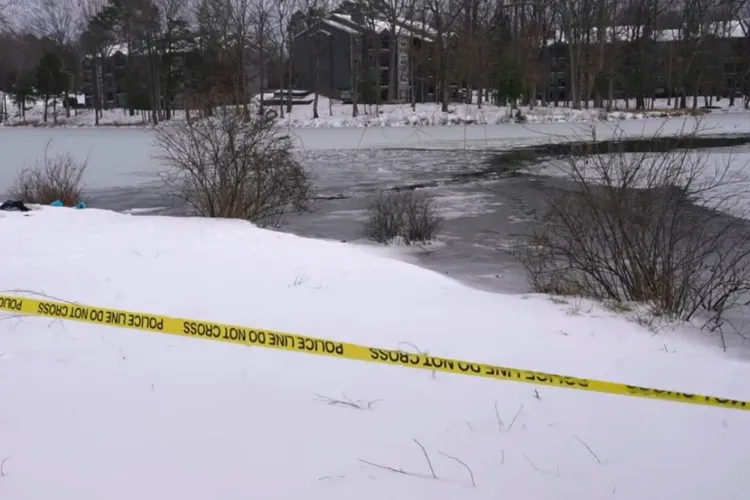
Police tape the pond in Henrico County, Virginia. Credit : WTVR CBS 6/Youtube
Credit : WTVR CBS 6/Youtube
A winter walk near a neighborhood pond in Virginia turned into a nightmare when a toddler slipped into the icy water and could not be saved, despite a stranger diving in after him. The boy was pulled out and rushed to a hospital, but he later died, leaving a community shaken and raising urgent questions about how fragile frozen ponds really are. The tragedy has also spotlighted the stranger’s desperate rescue attempt and the first responders who fought to keep the child alive.
As investigators piece together what happened around that frozen shoreline, safety officials across the region are using the case as a blunt warning. Thin ice, they say, is far more dangerous than it looks, and the heartbreak in Henrico County is exactly what they are trying to prevent as temperatures swing above and below freezing this winter.
The fall into the icy pond
The toddler was near a pond in Henrico County when he ended up in the frigid water, a moment that unfolded in seconds and left adults nearby scrambling to react. Police in Henrico County confirmed that the child went into an icy pond and that the surface did not hold, a reminder that even when water looks frozen, it may not be strong enough to support a small body. Neighbors described a chaotic scene as people realized the boy was in trouble and tried to figure out how to reach him without falling through the ice themselves.
One man did not wait for specialized gear. According to local reporting, a bystander jumped into the freezing water to pull the child out, acting on instinct rather than training. That stranger’s decision, detailed in coverage of the 4-year-old boy who fell through the ice, shows how quickly ordinary people can become first responders when a child is in danger. The water temperature, however, was brutally cold, and the boy had already been submerged long enough that every second counted by the time rescuers reached him.
A stranger’s rescue attempt and the fight to save him
Witnesses say the man who went in after the toddler did not hesitate, even as the icy surface cracked around him. He managed to reach the child and bring him back toward shore, where emergency crews were racing to take over. That split-second decision to jump in, echoed in multiple accounts of a 4-year-old boy being pulled from a frozen pond, underscores the raw human impulse to help, even when the conditions are life threatening for everyone involved.
Once the child was out of the water, first responders immediately began CPR on the shoreline, working in the cold as they tried to restart his heart and restore his breathing. Reports note that crews performed CPR and rushed the boy to a hospital with life threatening injuries, a standard protocol when a young child has been submerged in freezing water. Despite those efforts, and the stranger’s earlier rescue attempt, the toddler later died, a result that has left both the Good Samaritan and the professionals who tried to save him grappling with a loss they could not prevent.
First responders and a community in shock
For the firefighters, medics, and police who responded, the call was the kind that lingers long after the sirens are turned off. Video shared from the scene shows crews working around the pond as they pulled the child from the water in Henrico County, then carrying him toward an ambulance while continuing lifesaving measures. These are the moments that training prepares them for, but the emotional toll of losing a child is something no amount of drills can fully blunt.
Neighbors have been left replaying the afternoon in their minds, wondering if anything could have been done differently to change the outcome. Coverage of the case has described the boy as a toddler and a little boy, details that make the loss feel painfully personal for parents across the region. In a community where kids often play near retention ponds and small lakes, the idea that a quick walk outside could end this way has rattled families and prompted some to rethink how close their children get to the water’s edge in winter.
Warnings about thin ice and winter ponds
In the wake of the drowning, safety officials have been blunt: stay off the ice. Jan and other Officials have warned that lakes and ponds in the region are not reliably frozen, even when they look solid from the shore. Temperatures that bounce above and below freezing can create a deceptive crust on top of water that is still dangerously unstable underneath, especially near inlets, outlets, or spots where the current is stronger.
Those warnings have been repeated in coverage that notes multiple alerts in effect as winter weather systems move through. Jan and Close have stressed that even adults can misjudge ice thickness, so children have almost no chance of recognizing when a surface is unsafe. The message is simple but urgent: treat every frozen pond or lake as off limits, no matter how tempting it might be to step out for a quick slide or to chase a toy that has skittered across the surface.
How officials hope to prevent the next tragedy
Local leaders are now trying to turn heartbreak into prevention, using the Henrico County case as a real world example of what can happen when curiosity meets thin ice. In one briefing, Jan and other Officials pointed to the child’s fall through a frozen lake in Goochland County as part of a broader pattern of winter water emergencies. Goochland County Fire Captain Haley has been cited as one of the voices urging families to keep kids away from ice entirely, arguing that no photo, shortcut, or moment of fun is worth the risk of a rescue that might come too late.
Those warnings are being echoed in national coverage that has highlighted how quickly a child can slip under the surface. One report noted that first responders performed CPR and took the child to the hospital with life threatening injuries, a detail repeated in Close accounts of the incident. Another story, written by Gabrielle Rockson, described how Police in Henrico County confirmed the boy’s death and noted that local sources had described the frantic effort to save the child. In that coverage, the figure 41 appears in connection with Gabrielle Rockson’s byline, a small but precise detail that underscores how closely the reporting has tracked what happened.
Safety campaigns are also leaning on simple, memorable rules that parents can repeat with their kids. Some officials frame it as a basic winter checklist: do not walk on frozen ponds, do not let pets run onto the ice, and if someone falls in, call 911 and reach for them with a long object instead of stepping onto the surface. The NEED for families to KNOW these basics is being emphasized in coverage of Virginia incidents, where a few seconds of hesitation or a single misstep can be the difference between a close call and a funeral. For the community now mourning a toddler who never made it home from a winter walk, those rules are no longer abstract. They are the hard lessons written in the cold water of a neighborhood pond.
About the Author