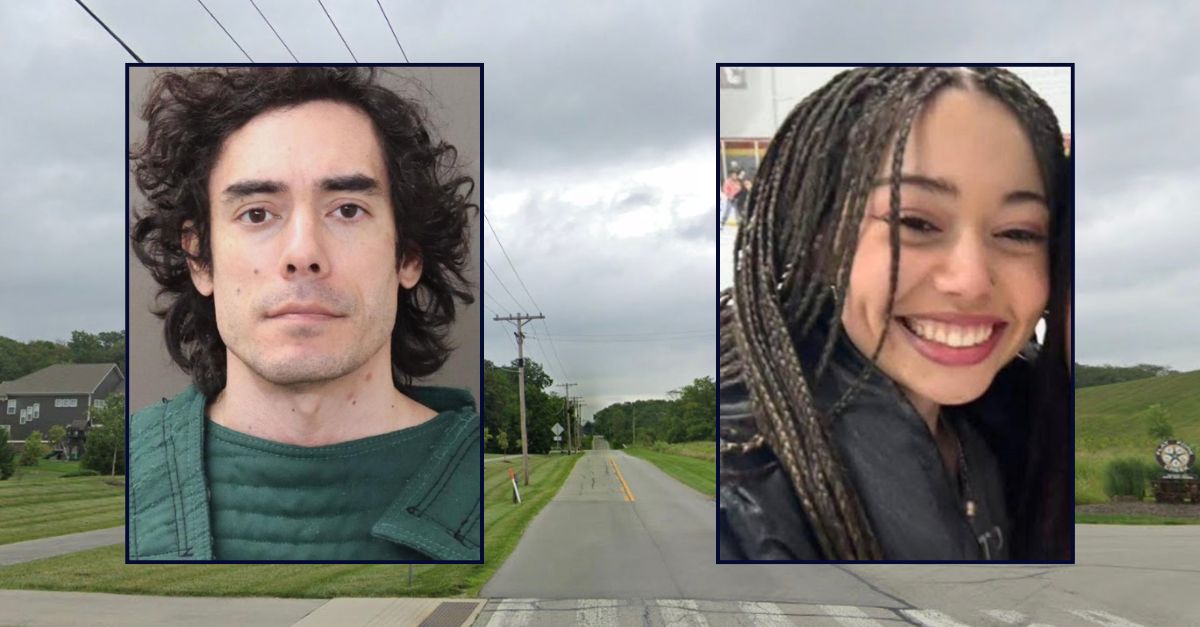
Inset, left to right: Tyler N. Thomas (Franklin County Jail) and Hailey Buzbee (Fishers Police Dept.). Background: The area in Indiana where Buzbee lived and was last seen alive (Google Maps).
A 17-year-old girl from Indiana went missing after meeting up with a man she first knew only as another player in an online game. Within weeks, the search for a runaway turned into a homicide case, and investigators say the man she met through gaming led them to her body in rural Ohio. What started as a digital friendship ended in a crime that now has parents and teens rethinking what it really means to “know” someone they only see on a screen.
Police say the teen, identified as Hailey Buzbee, left home believing she was meeting someone she trusted from the gaming world. Instead, her family is now planning a funeral, and a 39-year-old man is facing serious charges tied to her death. The case has unfolded across state lines, from her hometown in Indiana to a remote area of Ohio, and it is forcing a hard look at how predators can use everyday platforms like multiplayer games to reach kids.
The final meetup that changed everything
Investigators say Hailey Buzbee, 17, from the city of Fishers, was last seen leaving home after connecting with a man she met while playing online games. Police later identified that man as Tyler N. Thomas, who is 39, and who they say had been in contact with her through gaming before arranging to meet in person. According to authorities, the two met up in Indiana, then traveled together into Ohio, where the situation quickly shifted from a missing person case to a suspected homicide once officers began tracking their movements and reviewing digital evidence tied to the online contact.
Police in Fishers initially treated Hailey as a missing teen, but as days passed and leads pointed toward Ohio, the tone of the investigation shifted. Officials described the effort as a “recovery only” operation once they concluded she was no longer alive, and they focused on tracing the route she took after leaving home with the suspect. That shift came as detectives pieced together surveillance footage, phone records, and vehicle data that linked Hailey’s disappearance to the man she had met through gaming, prompting a multiagency search that stretched from Indiana into rural counties in another state and centered on the movements of Tyler Thomas.
From missing teen to confirmed homicide
As the investigation deepened, officers in Indiana coordinated with authorities in Ohio, where they say Thomas eventually directed them to a remote area where Hailey’s body was found. That discovery turned what had been a desperate search into a confirmed homicide case, with investigators now treating the site where she was recovered as a crime scene and gathering evidence to support charges tied to her death. Officials have said that the location was far from Hailey’s home, underscoring how quickly a teen can be isolated once they leave with someone they met online, and how dependent families become on digital breadcrumbs and the cooperation of suspects to find their children’s remains, a reality that played out when Thomas allegedly led law enforcement to the body.
Authorities in Indiana have publicly stated that Hailey Buzbee, 17, of Fishers, is dead, and that an Ohio man is in custody in connection with the case. Police described how she was last seen leaving home with the suspect and never returned, a detail that helped them narrow their focus to the man she had met through gaming and the vehicle they believe he used. At a press conference, officials emphasized that Hailey’s death is being treated as a criminal act, not an accident, and that the charges against the suspect reflect the seriousness of what happened after she left Fishers.
The 39-year-old suspect and the Ohio connection
Police say the man at the center of the case, Tyler N. Thomas, is 39 and from Ohio, and that he first came into Hailey’s life through an online gaming platform where they played together. Investigators allege that what started as in-game chat evolved into private conversations and eventually a plan to meet in person, with Thomas driving from Ohio to Indiana to pick her up. After Hailey vanished, officers tracked the pair’s movements back into Ohio, where they say Thomas was later arrested in connection with her death, a development that followed days of searching and ultimately tied the 39-year-old directly to the crime.
Reports describe Thomas as an Ohio resident who now faces serious charges after Hailey’s body was recovered in a different state from where she lived. Authorities have said that the distance between Fishers and the rural area where she was found is roughly a several-hour drive, highlighting how quickly a teen can be taken far from home once they get into a car with someone they met online. The case has also drawn attention to how law enforcement in Indiana and Ohio coordinated across jurisdictions to track Thomas, secure his arrest, and build a case that connects his online relationship with Hailey to the fatal outcome of their trip.
Who Hailey was before the headlines
Before her name was attached to a homicide investigation, Hailey Buzbee was a high school student with the usual mix of classes, friends, and online hobbies. She attended a local school in Indiana and, like many teens, spent part of her free time gaming and chatting with people she met on those platforms. Family photos shared publicly show a smiling teenager surrounded by relatives, including images credited as “Hailey BuzbeeCourtesy of Beau Buzbee/Facebook,” a reminder that behind the crime details is a daughter, classmate, and friend whose life was cut short after a meeting that started with a headset and a game invite, not a dark alley or a stranger’s van on a street corner, as reflected in the images shared by Beau Buzbee on Facebook.
Coverage of the case has emphasized that Hailey, 17, is now dead, and that her story is not just about a crime but about the everyday ways teens connect with people far outside their immediate circles. Writers like Escher Walcott, identified as a Writer and Reporter covering human interest and crime, have highlighted how Hailey’s age and the ordinary nature of her online life make the case especially unsettling for parents who see their own kids in her routine of school, gaming, and social media. The focus on her as a person, not just a victim, underscores why her death resonates so widely and why the details of how she met Thomas through gaming have become central to public conversations about online safety.
What parents and teens can take from a devastating case
Hailey’s death has quickly become a touchpoint in broader discussions about how families handle online gaming, especially when teens are chatting with adults they have never met in person. Experts and advocates often stress that games like Fortnite, Roblox, and Call of Duty are not just entertainment, they are social networks where strangers can build trust over time. The fact that Hailey met Thomas through gaming and then agreed to meet him in real life is now being used as a real-world example in conversations about setting boundaries, such as never sharing a home address, not meeting online contacts alone, and making sure parents know who is on the other end of a headset, themes that echo through crime coverage and resources like True Crime newsletters aimed at keeping families informed.
About the Author