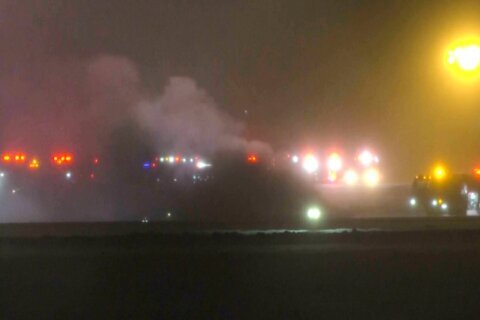
This image taken from video provided by WABI television, emergency services work on a scene of the Bombardier Challenger 600 crash at the Bangor Airport in Maine, late Sunday, Jan. 25, 2026. (WABI via AP)
The takeoff roll was supposed to be routine, a quick departure ahead of a fast–deteriorating winter storm. Instead, a private business jet lifting off from Bangor International Airport in Maine ended up inverted and broken apart near the runway, killing all six people on board. The crash, which unfolded as heavy snow and fierce winds moved in, has turned a familiar travel headache into a stark reminder of how unforgiving winter flying can be.
Investigators are now trying to piece together how a high-end jet, crewed and cleared for departure, could lose control so catastrophically in those conditions. Early details point to a brutal mix of weather, timing and the inherent vulnerability of aircraft to ice and low visibility, raising fresh questions about how far pilots and operators should push when storms are bearing down.
The final minutes on a stormy runway
The jet had paused in Bangor as part of a longer trip, with officials describing it as a Paris-bound luxury aircraft that stopped in Maine Sunday night before attempting to depart again into worsening snow. Airport director Jose Saavedra said the aircraft taxied to the runway as the storm intensified, with visibility dropping and snow piling up around the field. The airport later announced it would remain closed until at least 9 a.m. Thursday so crews and investigators could safely work around the wreckage, a sign of just how disruptive and dangerous the conditions had become.
On the tower frequency, controllers were already on edge. About half an hour before the crash, the pilot of a Florida-bound Allegiant flight radioed that he was aborting his own takeoff, citing the conditions before taxiing back. When the business jet tried to depart, an audio recording captured someone on frequency saying, “Aircraft upside down. We have a passenger aircraft upside down,” as responders rushed toward the scene described in one report from Portland, Maine.
A high-end jet, a law firm trip, and no survivors
The aircraft involved was a Bombardier Challenger 650, a wide-bodied business jet often used for corporate and long-haul charter flights. Officials said the plane was operating out of Bangor International Airport and was linked to a Houston law firm, with the trip reportedly tied to business travel. The Challenger 650 is built for range and comfort, but like any jet it is at the mercy of runway conditions and airframe icing, especially during the most vulnerable phase of flight, the takeoff roll.
All six people on board were killed. According to the FAA, Four of the passengers were traveling in the cabin and the other two were flight crew, and there were no survivors. Social media posts and local coverage have begun to identify some of the victims, with at least three of the six described as prominent Houston attorneys and colleagues connected to the same firm, according to friends and family quoted in a report from Maine.
Winter flying, ice, and an investigation slowed by snow
For pilots, the setup that night reads like a checklist of red flags. A brutal system was bearing down on the region, with a BRUTAL Winter Storm described as hitting at the Worst Possible Time for departures, as one Winter Storm clip put it. Aviation experts have long warned that even a little bit of ice on the wings can cause serious problems, robbing an aircraft of lift and stability, which is why careful inspections and de-icing are treated as non-negotiable steps before takeoff in freezing conditions, a point underscored in coverage of the winter crash.
Federal investigators from the National Transportation Safety Board and the FAA now face the awkward task of probing a crash scene that is itself being reshaped by the same weather that helped cause it. The airport has said the field will stay closed until at least Thursday morning while teams document debris, examine the engines and control surfaces, and review the jet’s maintenance and de-icing records, as described in an update on the Paris-bound flight. The National Transportation Safety Board has already noted that Six people died when the business jet crashed during takeoff as a snowstorm moved in and visibility diminished in Maine Sunday night, a framing that will guide its work, according to a detailed account from Maine Sunday.
Local coverage has emphasized how sudden the disaster felt on the ground, with one television segment noting that six people died when their plane went down at the Bangor Bangor airport in Maine the jet had taken off from Hobby on Sunday and was carrying professionals whose names are now slowly being released, as seen in a Sunday broadcast. Another report summed it up bluntly, saying Six people died when a business jet trying to take off in Maine crashed in a snowstorm, a line that captures both the scale of the loss and the central role of the weather, as noted in a story from Six. For families in Houston and Bangor alike, the technical findings that will eventually emerge from this investigation will matter, but for now the crash is a raw, personal tragedy that unfolded in the span of a single, ill-fated takeoff roll.
About the Author