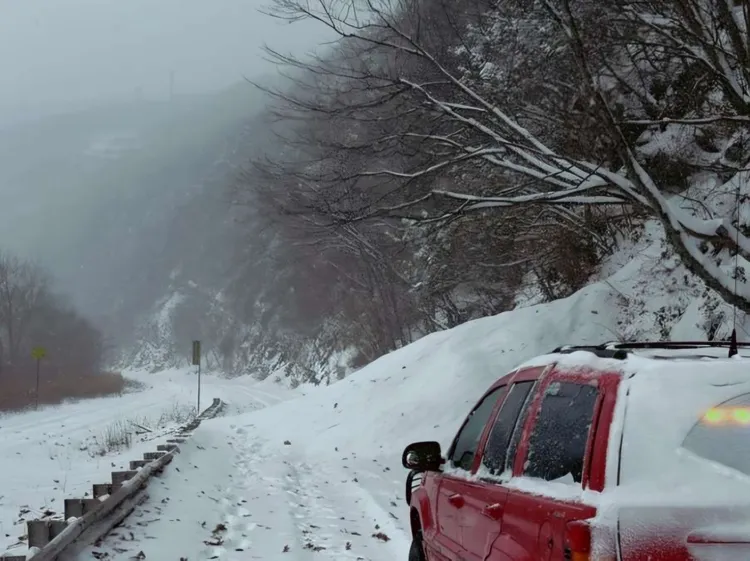
Avalanche on Coxton Road in Luzerne County, Penn. on Jan. 25, 2026. Credit : Duryea Fire Police
Credit : Duryea Fire Police
Drivers in northeastern Pennsylvania are used to white-knuckle winter commutes, but they are not used to seeing a wall of snow suddenly swallow a road. During Winter Storm Fern, a rare avalanche crashed down a steep slope in Luzerne County and left a key stretch of pavement completely impassable, turning an ordinary snowy Sunday into something that looked more like the Rockies than the Susquehanna Valley. The slide shut down traffic, stunned locals and emergency crews, and offered a blunt reminder that as storms get stronger, even familiar landscapes can behave in unfamiliar ways.
Officials later confirmed that the buried road was eventually dug out and reopened after crews spent hours carving through the debris. By then, the avalanche had already carved its own place in local memory, joining a growing list of extreme winter moments that are reshaping how Pennsylvania communities think about snow, ice, and the risks that come with both.
When Winter Storm Fern Turned a Back Road Into a Dead End
The trouble started when Winter Storm Fern parked over large parts of Pennsylvania and dropped the kind of heavy, wet snow that sticks to every ledge and ledge-like surface it can find. In Luzerne County, that meant the steep hillside above Coxton Road in Duryea, where a deep load of snow finally gave way and thundered down onto the pavement. Local reports described the slide as a “large snow avalanche” that piled so much snow onto the roadway that it was simply not passable, a rare enough event in this part of the state that even seasoned plow drivers had to do a double take as they rolled up to the scene, a moment captured in early coverage of the snow piled across the asphalt.
State and local agencies quickly treated the slide as more than just another drift. A major winter storm had already been hammering PENNSYLVANIA with snow and wind, and the avalanche added a new layer of risk for anyone trying to navigate the back roads along the Susquehanna River. Traffic advisories urged drivers to avoid the area after the “ultra rare” slide hit a Pennsylvania road in the north of the state on Sunday afternoon, language that underscored just how unusual it is to see a true avalanche in this region and that was echoed in descriptions of an ultra rare avalanche hitting the roadway.
Coxton Road Buried, Then Dug Back Out
On the ground, the scene on Coxton Road was jarring. Photos and video shared from Duryea showed a thick, jagged mound of snow and ice stretching across the full width of the pavement, with tree limbs and chunks of hillside mixed into the mess. A local alert described it bluntly as “BREAKING: AVALANCHE BURIES COXTON ROAD IN DURYEA, LUZERNE COUNTY, PENNSYLVANIA,” capturing both the shock and the scale of the slide as residents tried to process the idea that an avalanche, not a plow berm, had closed their road, a description that matched the social media post declaring that an AVALANCHE BURIES COXTON.
Officials stressed that the slide was rare but not imaginary, pushing back on early skepticism that it might just be a dramatic way to describe a plow pile. NEED TO KNOW bulletins about Winter Storm Fern spelled out that the storm had triggered a rare avalanche in one Pennsylvania county and forced the closure of a road, language that lined up with what drivers were seeing in Duryea and that framed the event as a genuine hazard rather than a social media exaggeration. Those same updates noted that the “large snow avalanche” had left the road impassable until crews could move in, a point reinforced in summaries that highlighted how Winter Storm Fern caused the rare slide and forced the closure.
Why Avalanches Are So Unusual In Pennsylvania, And What Comes Next
Part of what made the Coxton Road slide so startling is that Pennsylvania is not avalanche country in the way that Colorado or Utah is. The state has hills and even some steep ravines, but it lacks the kind of sustained high alpine terrain that usually breeds large, fast-moving snow slabs. Meteorologists pointed out that Pennsylvania rarely sees true snow avalanches because of that topography, which is why this event stood out as a “Rare” avalanche that blocked a road during a major snowstorm and joined a broader pattern of intense winter weather that has stretched from the Mid-Atlantic into parts of New England, a pattern described in coverage of a Rare avalanche blocking a Pennsylvania road.
That broader pattern is still unfolding. Even as Luzerne County dug out, other parts of the state were staring down fresh alerts, including a COLD WEATHER ADVISORY for Berks County, PA, USA that flagged dangerously low wind chills and urged residents to limit time outside. The advisory, shared as an URGENT WEATHER MESSAGE from the National Weather Service, underscored that the atmosphere is not done throwing curveballs at Pennsylvania this winter, and it served as a reminder that the same cold, dense air that fuels avalanches on steep slopes can also turn a routine walk to the car into a frostbite risk, a warning captured in the COLD WEATHER ADVISORY for Berks County.
About the Author