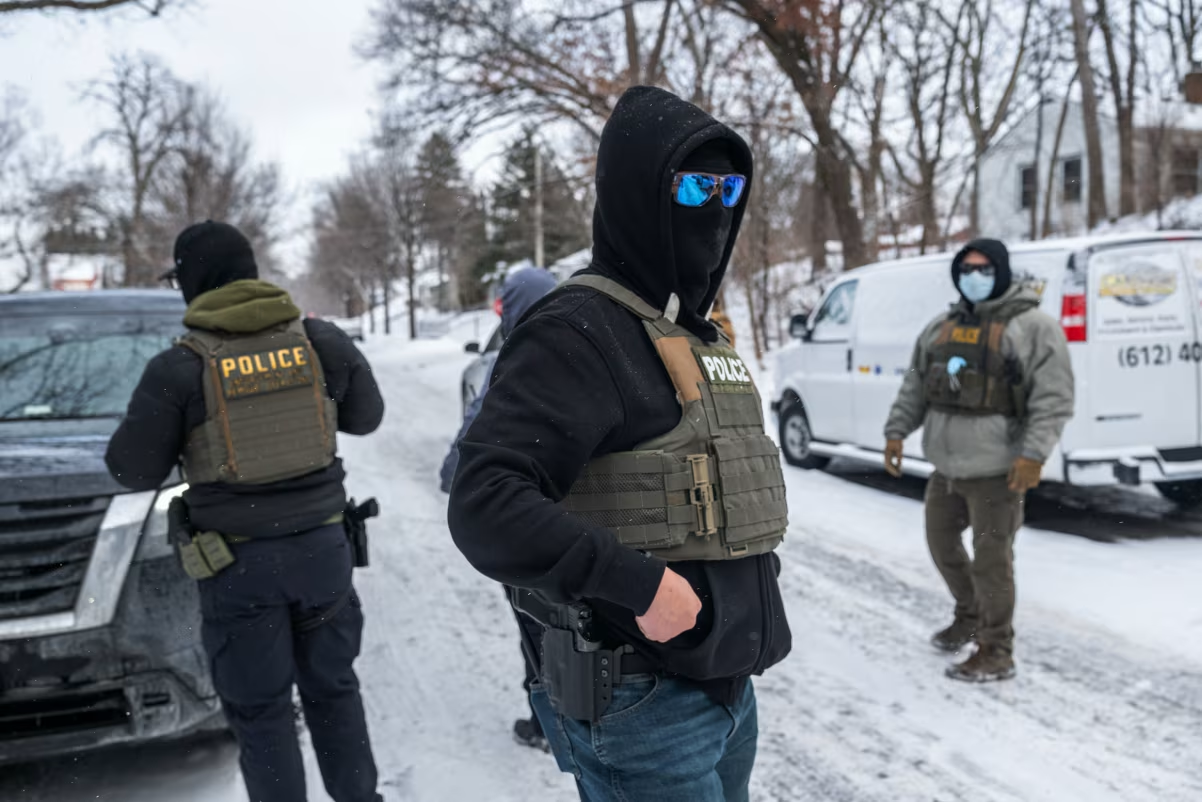
Federal law enforcement agents outside a private residence in St. Paul, Minnesota, on January 18. Victor J. Blue/Bloomberg/Getty Images
Attorney General Pam Bondi has turned a local immigration crisis in Minneapolis into a national fight over voter data, telling Minnesota governor Tim Walz that granting federal access to the state’s voter rolls could avert what she called another “national tragedy.” Her demand, delivered in a sharply worded letter after the killing of Alex Pretti by a federal immigration agent, links election systems, welfare records, and street violence in a way that has alarmed civil rights advocates and election experts. I see in her argument a revealing test of how far the Trump administration is willing to go to fuse immigration enforcement with the machinery of American democracy.
At stake is not only who controls sensitive information about millions of Minnesota residents, but also whether the federal government can leverage the presence of Immigration and Customs Enforcement in local jails to pressure a state into opening its election infrastructure. Bondi’s insistence that voter roll access is a prerequisite for restoring order in Minneapolis has drawn accusations of blackmail and ransom, and it raises hard questions about what counts as legitimate federal oversight and what crosses into coercive overreach.
The flashpoint: a killing, a letter, and a sweeping demand
The immediate backdrop to Bondi’s ultimatum is the death of US citizen Alex Pretti, who was shot and killed by a federal immigration agent in Minneapolis. According to a detailed account of the aftermath, “Last night, following the heinous murder of US citizen Alex Pretti at the hands of a federal immigration agent, Pam Bondi drafted” a letter that would quickly escalate from a response to one killing into a broader indictment of Minnesota’s policies and data practices, a move that local leaders like DNC Chair Ken Martin have treated as a political escalation rather than a narrow law enforcement response Last. In that context, Bondi framed Pretti’s death not as an isolated tragedy but as proof that Minnesota’s approach to immigration and public safety had spiraled out of control.
U.S. Attorney General Pam Bondi wrote directly to Minnesota Gov. Tim Walz after what one account described as “the death of another American citizen at the hands” of a federal immigration agent, casting the incident as part of a pattern of violence tied to state policy choices rather than a single officer’s misconduct American. In that letter, she did not limit herself to criticizing Minnesota’s cooperation with ICE, but instead moved quickly to argue that access to voter rolls and welfare data was essential to preventing future bloodshed, setting the stage for the extraordinary linkage between election records and street violence that now defines the dispute.
How ICE tensions in Minneapolis became leverage over voter data
Bondi’s intervention landed in the middle of a separate but related fight over Immigration and Customs Enforcement access to local jails in Minnesota, where federal officials have been pressing for broader cooperation from county sheriffs. Reporting on those negotiations notes that “But Homan is not the only Trump administration official to give Minnesota officials an ultimatum in recent days,” and that “On Saturday, US Attorney General Pam Bondi” added her own conditions, tying the presence of federal immigration agents in Minneapolis to concessions from the state on data sharing from the Department of Justice But Homan. In other words, what began as a dispute over whether ICE could pull people from local custody has morphed into a bargaining table where voter rolls and welfare records are suddenly in play.
Local coverage of the standoff describes how Bondi’s “injection of voter roll demands into Minneapolis ICE tensions” has drawn accusations that she is effectively holding the city’s safety hostage, with critics saying the federal government is using the threat of continued immigration raids as leverage to obtain data it has struggled to get through other channels Bondi’s injection. I see that dynamic as central to understanding why the fight has resonated far beyond Minnesota: it is not just about one state’s records, but about whether federal law enforcement can tie basic public safety functions to unrelated demands for election and welfare data.
Inside Bondi’s letter: from “out of control fraud” to “national tragedy”
Bondi’s letter to Walz is striking for how quickly it moves from the specific facts of Alex Pretti’s killing to sweeping claims about Minnesota’s elections. In one passage, she writes, “And the out of control fraud in your state also implicates election security,” before adding that “It is a tragedy that Americans have lost faith in” the integrity of the system, language that casts Minnesota not just as a policy outlier but as a national weak point in the broader fight over voting rules And the. I read that framing as an attempt to transform a state-level dispute into a referendum on whether the federal government should have more direct control over how voter information is managed.
In a January 24 letter to Minnesota governor Tim Walz about ICE’s presence in Minneapolis, Attorney General Pam Bondi reiterated a series of demands that went well beyond immigration enforcement, insisting that Minnesota provide federal authorities with access to its voter rolls and other data as part of what she described as a necessary reset of the relationship between the state and ICE January 24 letter. That document, circulated widely on social media, crystallized her argument that the same state officials who had, in her view, failed to protect federal agents and residents in Minneapolis had also presided over what she called systemic election problems, and that both issues could be addressed only if Walz agreed to open up Minnesota’s databases.
Bondi’s core claim: voter rolls as a tool to prevent violence
Bondi’s most explosive assertion is that giving the federal government access to Minnesota’s voter rolls could help prevent another catastrophe like the killing of Alex Pretti. One widely shared account summarized her message this way: “Pam Bondi Tells Tim Walz That Handing Over Minnesota’s Voter Rolls Can Help Prevent Another ‘National Tragedy’,” capturing her argument that the same data used to administer elections could be repurposed to identify threats and restore order after the shooting Pam Bondi’s. I see in that claim a deliberate blurring of lines between election administration and public safety, with Bondi suggesting that the integrity of one is inseparable from the other.
Another passage from the same coverage notes that “Pam Bondi Tells Tim Walz That Handing Over Minnesota’s Voter Rolls Can Help Prevent Another ‘National Tragedy’,” and that she specifically tied this to federal “access to Minnesota’s voter rolls,” arguing that only by cross-referencing election data with other federal systems could authorities fully understand who was in the state and how they were interacting with public benefits and law enforcement Pam Bondi Tells. That logic treats voter registration records as a kind of master key for federal surveillance and enforcement, a vision that goes far beyond traditional notions of election security and into a more expansive, and contested, model of data-driven policing.
Beyond elections: welfare data, law and order, and federal reach
Bondi’s demands do not stop at voter rolls. Attorney General Pam Bondi is pushing Minnesota Gov. Tim Walz to let the federal government access the state’s voter rolls and public assistance records, including data on Medicaid and SNAP recipients, in what she has framed as an effort “to help bring back law and order” in the wake of the shootings and ongoing unrest Attorney General Pam. That request would give federal authorities access to information on millions of U.S. residents, far beyond those directly implicated in any immigration or criminal investigation, and it underscores how the Minneapolis crisis has become a vehicle for a much broader data grab.
Another account describes how Attorney General Bondi Demands Access to Minnesota’s Voter Rolls and Welfare Data, quoting language that says Attorney General Pam Bondi is insisting on these records so that the Department of Justice can verify whether state practices “comply with federal law,” a justification that wraps the request in the language of oversight even as it vastly expands the scope of federal review Attorney General Bondi. I read that as part of a pattern in which the Trump administration uses moments of crisis to justify new forms of data collection, arguing that only by centralizing information in Washington can it guarantee both security and legal compliance.
Walz’s position and Minnesota’s pushback
From the state’s perspective, Bondi’s demands collide with both legal constraints and political resistance. One detailed report notes that “The DOJ has declined those offers,” referring to earlier attempts by Minnesota officials to negotiate more limited forms of cooperation, and adds that “Attorney General Bondi knows full well that the Governor has no formal role in managing our elections,” a reminder that in Minnesota, as in most states, election administration is handled by other constitutional officers rather than the governor alone The DOJ. That point undercuts Bondi’s suggestion that Walz could simply hand over voter rolls on his own authority, and it highlights the structural limits on how quickly any state could respond to such a sweeping federal request.
At the same time, Bondi’s critics in Minnesota argue that her portrayal of the state as uniquely chaotic is itself misleading. One account of her letter notes a section labeled “NEED TO KNOW,” which asserts that the violence in Minneapolis is “a result of Walz’s governing,” a claim that Walz allies have rejected as a partisan attack that ignores the role of federal agents and national political rhetoric in fueling tensions NEED TO KNOW. I see that clash as emblematic of a deeper disagreement: Bondi wants to cast Minnesota’s leadership as the primary culprit and justify extraordinary federal intervention, while Walz and his allies insist that any solution must start with accountability for federal actions in Minneapolis.
Election experts and civil rights advocates cry foul
Outside Minnesota, election and civil rights experts have warned that Bondi’s approach risks normalizing the use of voter data for purposes far removed from running elections. One analysis notes that on Saturday, Attorney General Pam Bondi publicly linked “Minneapolis violence” to “voter data,” arguing that unrest in the city was tied to what she described as lax election practices and that federal authorities needed access to those records to restore order Bondi Links Minneapolis. I read that linkage as a significant escalation, because it suggests that any episode of urban unrest could be used as a pretext to demand election data, blurring the line between public safety and political oversight.
Critics have not minced words in describing what they see as the stakes. Arizona Secretary of State Adrian Fontes said Bondi’s letter suggested that Minnesota can expect more violence from federal immigration agents if it does not comply, a reading that has led some advocates to label the demand “blackmail” and to argue that using the threat of force to obtain voter rolls is fundamentally incompatible with democratic norms Arizona Secretary of. From my perspective, that criticism underscores how Bondi’s strategy is being read not just as a policy disagreement, but as a test of whether the federal government can use the specter of “chaos” to pry open state election systems.
Progressive backlash and the politics of “chaos”
Bondi’s rhetoric has also drawn sharp responses from national progressive figures who see her demands as part of a broader pattern in the Trump era. One widely circulated piece highlighted how “Politics: AOC’s Damning Takedown Of Kristi Noem Goes Viral: ‘How Rich It Is…’,” using that viral moment to frame a broader critique of Homeland Security Secretary Kristi Noem and Attorney General Bondi’s handling of Minneapolis, and noting that, according to Bondi, the widespread protests against ICE in Minnesota would stop only if state officials agreed “to yield to her demands” on data access Politics. That framing casts Bondi’s approach as part of a coordinated strategy by senior Trump administration officials to portray dissent as “chaos” that can be quelled only through expanded federal power.
About the Author