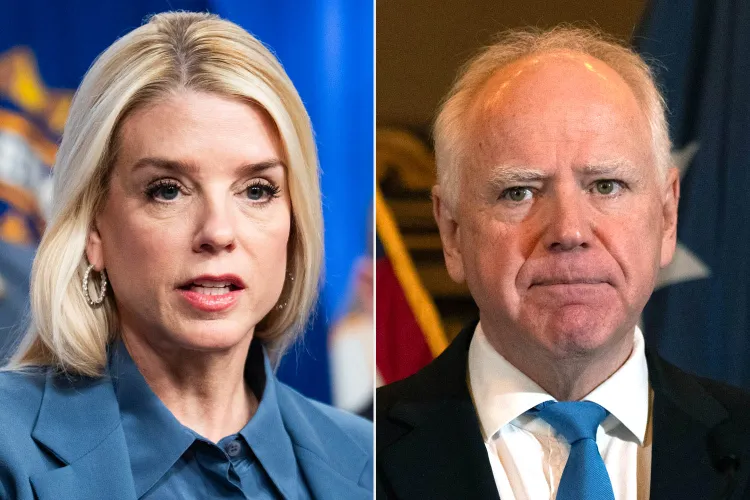
U.S. Attorney General Pam Bondi wrote a letter of demands to Minnesota Gov. Tim Walz after Border Patrol fatally shot a U.S. citizen on Jan. 24, 2026. Credit : Tom Williams/CQ-Roll Call, Inc via Getty; Jerry Holt/The Minnesota Star Tribune via Gett
Credit : Tom Williams/CQ-Roll Call, Inc via Getty; Jerry Holt/The Minnesota Star Tribune via Gett
Attorney General Pam Bondi has turned a local immigration flashpoint in Minneapolis into a national fight over data, democracy, and the limits of federal power. In a blunt letter to Minnesota governor Tim Walz, she argued that giving her Justice Department access to the state’s voter rolls could help avert what she called another “national tragedy,” tying election records to both street violence and faith in government.
The pitch lands at a volatile moment, coming after the killing of American citizen Alex Pretti by a federal immigration agent and amid tense standoffs over Immigration and Customs Enforcement operations in Minnesota jails. Bondi is betting that fear, frustration, and confusion will be enough to sell an extraordinary data grab as a public safety fix.
Bondi’s sweeping ask: voter rolls, welfare files, and a warning to Walz
In her letter to Minnesota Gov. Tim Walz, Attorney General Pam Bondi framed the death of Alex Pretti as the breaking point that justified a hard reset of the state’s relationship with Washington. According to a post describing the message, U.S. Attorney General Pam Bondi wrote to Minnesota Gov. Tim Walz after the death of another American citizen at the hands of a federal immigration agent, casting the killing as proof that Minnesota’s current approach had failed and that the governor’s policies were putting both residents and federal personnel at risk, a point highlighted in a Facebook post. Another account of the letter notes that Bondi wrote after the “heinous murder” of US citizen Alex Pretti, arguing that Minnesota’s immigration policy was endangering agents and citing criticism from DNC Chair Ken Martin, as detailed in a local report. She used that emotional backdrop to demand that Walz open up Minnesota’s most sensitive databases.
Bondi’s ask was not limited to election files. She pressed Walz to let the federal government access the state’s full voter rolls and public assistance records, including Medicaid and SNAP data on millions of U.S. residents, arguing that this information would help “bring back law and order” in the wake of the shootings, according to a detailed account. Another summary of her push notes that Attorney General Bondi is demanding access to Minnesota voter rolls and welfare data so the Justice Department can review whether the state’s practices comply with federal law, as described in a national broadcast. In a separate analysis, Bondi’s broader campaign is described as an unprecedented effort by the department to gather full voter rolls from states, a push that has already run into setbacks in court and drawn scrutiny from groups like the Center for Election Innovation & Research, as outlined in a legal review.
From ICE standoff to “national tragedy” rhetoric
Bondi’s letter did not arrive in a vacuum. Minnesota has been locked in a bitter fight with the Trump administration over how Immigration and Customs Enforcement can operate in local jails, with federal officials accusing the state of obstructing immigration enforcement and state leaders accusing Washington of heavy handed tactics. One report notes that But Homan is not the only Trump administration official to give Minnesota officials an ultimatum in recent days, and that on Saturday a U.S. Attorney from the Department of Justice joined the pressure campaign over ICE access to jails, according to a CNN analysis. In that context, Bondi’s demand for voter data reads less like a one off request and more like part of a coordinated strategy to leverage federal power against a resistant state government.
Bondi herself has been explicit about tying the unrest in Minneapolis to access to voter data. A detailed critique notes that on Saturday, Attorney General Pam Bondi linked violence in Minneapolis to the state’s refusal to let her department illegally access voter data, folding election records into her explanation for why protests and clashes had spiraled, as described in a civil liberties analysis. Another report on the Minneapolis tensions describes how Bondi’s injection of voter roll demands into the ICE dispute has drawn accusations that she is effectively holding the city hostage, with critics likening the offer to ease federal pressure in exchange for data to a form of ransom, as laid out in a regional report. The escalation shows how quickly a fight over jail access can morph into a referendum on who controls the digital backbone of American democracy.
“National tragedy” or political leverage? Critics push back
About the Author