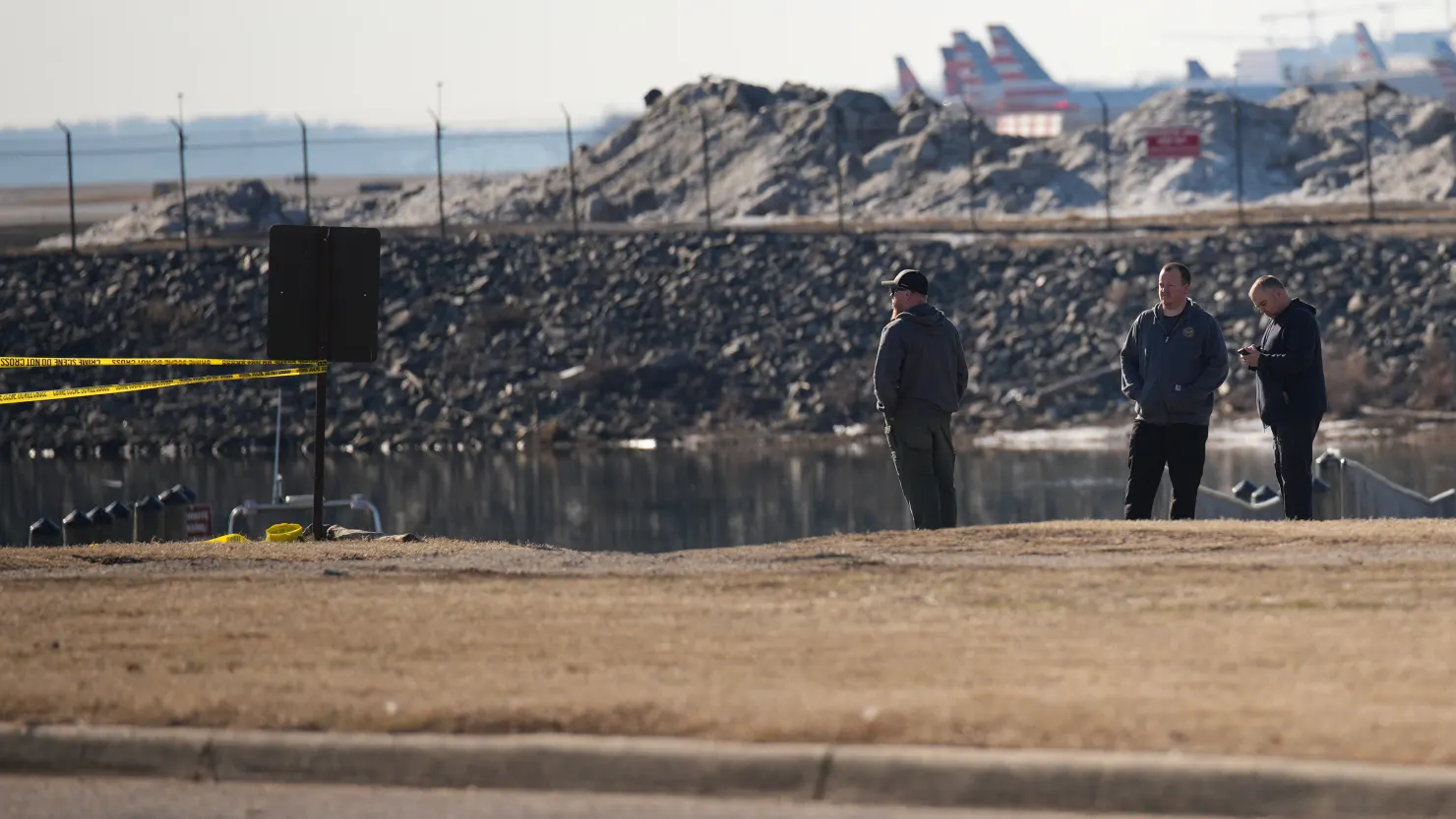
People look out towards the crash site of the American Airlines plane on the Potomac River as it approached the Reagan National Airport on January 30, 2025 in Arlington, Virginia. Andrew Harnik | Getty Images
Andrew Harnik | Getty Images
The midair collision that sent an American Airlines jet and an Army helicopter into the Potomac River did not come out of nowhere. Investigators now say the Army crew likely had a visual on the airliner before impact, a detail that sharpens the focus on human judgment and systemic breakdowns rather than freak bad luck. As families of the 67 people who died keep pushing for answers, the emerging picture is of a tragedy that experts increasingly describe as avoidable.
What is coming into view is a chain of missed chances, from cockpit to control tower to federal policy. The Army Black Hawk crew, the American Airlines Flight 5342 pilots, and the people managing the crowded airspace around Washington were all operating inside a system that, according to federal safety officials, was riddled with gaps long before the two aircraft crossed paths.
What investigators say the Army crew could see
Federal investigators have zeroed in on what the Army Black Hawk crew actually saw in the final seconds before the collision with American Airlines Flight 5342. A visibility study presented to the National Transportation Safety Board suggests the helicopter’s pilots, even while using night-vision goggles, should have been able to pick out the regional jet’s lights against the dark backdrop as the two aircraft converged near Washington. Officials now believe the crew of the Army Black Hawk had enough visual cues to recognize the American Airlines Flight ahead of them and understand the danger they were in, yet the closing speed and workload in the cockpit meant that recognition did not translate into effective avoidance.
That conclusion is backed up by a separate presentation that walked through what each cockpit likely looked like in real time. In that reconstruction, the Army crew’s view of the American Airlines jet was not perfect, but it was not invisible either, which is why investigators say the helicopter was “able to see” the airliner well before the rotor blades sliced into the jet’s tail. The finding, laid out in detail in one account of the, has become a central piece of the case that this was not an unavoidable blind collision but a failure of perception, training, and coordination.
A “deep” systems failure, from the tower to cheap tech that was never installed
Investigators are not stopping at what the pilots saw out the window. The National Transportation Safety Board Chai has described the crash as the product of “deep” systemic failures that stretched from the National Airport control tower to the policies governing how military helicopters mix with commercial traffic over the Potomac. In the tower, one controller was described as task-saturated, juggling close helicopter routes and a stream of airline departures and arrivals, a setup that the NTSB says created fertile ground for mistakes and what one report called expectation bias, the human tendency to see what you expect instead of what is actually there. Those concerns are laid out in detail in an analysis of the findings.
On the technology side, NTSB chair Jennifer Homendy has been blunt about how little it might have taken to change the outcome. Earlier during Tuesday’s hearing, Homendy pointed to a $400 GPS device known as ADSB-In, saying that if either cockpit had been equipped with the relatively cheap gear, each crew would have seen the other aircraft’s position and altitude on a screen instead of hunting for lights in the dark. The board’s staff has said that a $400 G unit with ADSB could have provided the kind of traffic picture that might have broken through the fog of workload and expectation bias, a point underscored in a detailed discussion of the technology.
Reconstructing the night over the Potomac and the human cost below
To understand how those systemic flaws played out in the sky, investigators have leaned heavily on a simulation that recreates the collision from the Army crew’s perspective. That simulation, presented in a public hearing, shows how the helicopter’s night-vision goggles narrowed the pilots’ field of view and how the American Airlines jet’s lights would have appeared in that green-tinted tunnel. The Army research team used the simulation to argue that while the pilots had limited visibility, they still had windows of time when the jet was in view, a conclusion that feeds directly into the NTSB’s criticism of Army training and cockpit procedures. Details of that simulation and the Army’s role are laid out in a review of Army and FAA failures.
On the civil side, the NTSB has emphasized that both aircraft struggled to see each other in time, which is why Homendy has called the crash “100% preventable” if modern traffic awareness tools had been in place. The NTSB staff has said the aircraft had difficulty spotting one another visually in the cluttered airspace, a point that reinforces the board’s push to make ADSB standard equipment rather than an optional upgrade. That argument is spelled out in a summary of what believes went wrong.
About the Author