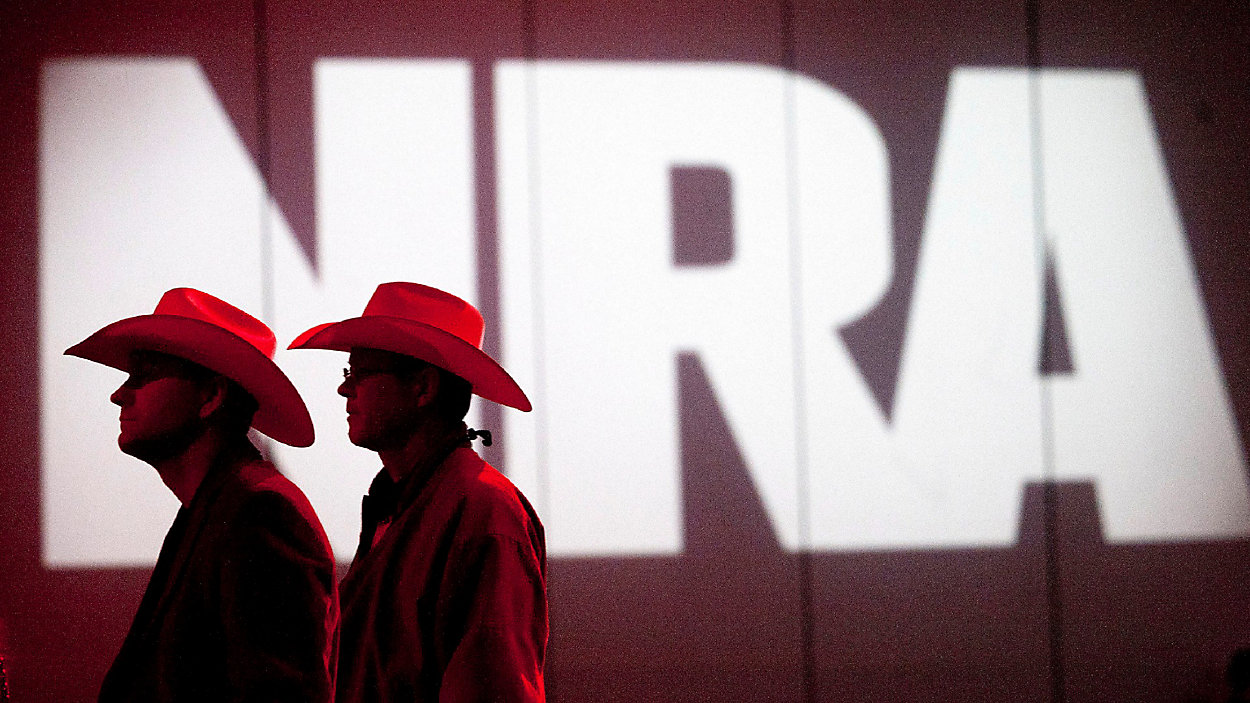
National Rifle Association members listen to speakers during the NRA's Annual Meetings and Exhibits at the George R. Brown Convention Center, May 4, 2013, in Houston. (Johnny Hanson/Houston Chronicle via AP, File)
The shooting of Alex Pretti by federal immigration officers in Minneapolis has done something American politics almost never sees anymore: it has put President Donald Trump and the National Rifle Association on opposite sides of the same argument. What started as a familiar law‑and‑order defense of federal agents has turned into a public clash over whether simply carrying a gun near a protest should be treated as inherently suspect. The NRA’s unusually sharp response signals that, for once, the country’s most powerful gun lobby is willing to call out a friendly administration when it thinks core Second Amendment lines are being crossed.
At the center of the fight is a basic question with huge implications: if a person like Alex Pretti is legally armed, how far can the government go in using that fact to justify deadly force or sweeping new limits on where guns are allowed? The answer will shape not just the fallout from one Minneapolis Saturday, but the future of the alliance between Trump and the gun movement that helped put him in the White House.
From Minneapolis shooting to political rupture
Alex Pretti was shot and killed by federal immigration officers in Minneapolis Saturday during an operation that quickly spilled into national politics. In the hours and days after Pretti’s death, officials in The Trump administration framed him as an armed threat, saying Pretti carried a gun and posed a danger to officers even though no available video shows Pretti holding a weapon, a gap that has fueled anger among gun owners and civil libertarians alike, as detailed in one account. Gun ownership advocates who had backed Alex Pretti’s legal carry of a gun saw those early statements as an attempt to criminalize the simple fact that he was armed, and they began pushing back hard against the narrative coming out of Washington, according to reporting on how gun rights groups reacted.
That tension exploded into the open when President Donald Trump was asked about the case and responded that “you can’t have guns” in that kind of situation, a remark captured in a local interview. President Trump appeared to break with Second Amendment advocates who had defended Alex Pretti’s right to be armed, with one analysis noting that President Donald Trump seemed to distance himself from those who argued Pretti’s legal carry should not be used against him, as described in a Topline summary. As commentators like KEITH put it in one radio discussion, the president’s response was very focused on Pretti’s gun rather than on the disputed details of the encounter itself, a framing that has been highlighted in a transcript.
Inside the broader gun movement, that shift landed like a thunderclap. Gun ownership advocates who had long treated Trump as an ally suddenly heard the president echoing arguments they usually expect from gun control groups, and they said so publicly in coverage of how Gun rights groups blast Trump over Minnesota response, including one piece that quoted activists warning that the government cannot treat carrying a firearm as a “right to break the law,” a line that appears in a detailed Politico excerpt. The result is a rare moment when the political lines around guns look scrambled, with traditional allies suddenly arguing over what it means to “back the blue” without throwing lawful gun owners under the bus, a dynamic that has been explored in coverage of how the Minnesota shooting has blurred political lines around guns, including one segment.
The NRA’s unusually sharp pushback
The National Rifle Association did not just quietly grumble about the White House line, it went public. The NRA and other US gun activists issued a rare collective rebuke of The Trump administration after officials repeatedly emphasized that Pretti had a gun and suggested he was out to harm officers, a coordinated response described in one analysis. The NRA went further by directly criticizing a federal prosecutor, Essayli, whose social media post portrayed Pretti as a violent aggressor; The NRA called Essayli’s statement “dangerous and wrong” and urged public officials to wait for a full investigation instead of rushing to justify the shooting, language that appears in a detailed summary. Another report on how the NRA slams federal prosecutor’s post about Minneapolis shooting captured the group’s warning that such rhetoric is “Dangerous and wrong” and noted the Close Tensions already flaring in Minneapolis, as laid out in a KBTX piece.
About the Author