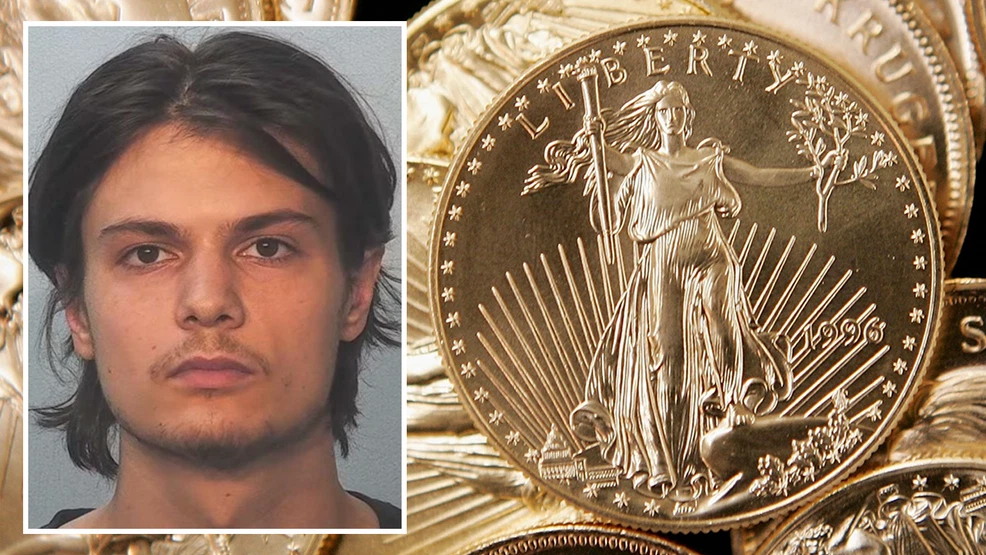
Chavez Gustin, 22, was sentenced to decades in prison after he murdered a man so he could steal thousands of dollars worth of gold coins. He was caught just days later when he attempted to sell the gold coins at a pawn shop. (Allen County Sheriff's Department, Photo Illustration by Scott Olson/Getty Images)
The killing started with a simple plan to flip some gold coins for cash. Prosecutors say a 22-year-old buyer met a stranger, shot him, stole his coins, then tried to turn those same pieces of metal into quick money at a pawn shop. By the time the case reached a courtroom, the story had become a grim example of how a casual online sale can spiral into lethal violence.
What followed was a trail that ran from a Facebook Marketplace listing to a bar meetup, a basement office, and finally a pawn counter, where the stolen American Eagle coins helped police close in. The man at the center of it, Chavez Gustin, is now facing decades behind bars after a judge handed down a 55 year sentence for felony murder.
The Marketplace Deal That Turned Into a Trap
Investigators say the whole thing began when the victim advertised several American Eagle gold coins on Facebook Marketplace, looking to sell them for thousands of dollars. According to court records, the seller agreed to meet a prospective buyer, later identified as Chavez Gustin, at a local bar to talk through the deal and arrange payment for coins valued around $4,400. That seemingly routine meetup, set up the way people sell used cars or gaming consoles every day, instead became the setup for a robbery that would end in gunfire, with the coins at the center of the plot described as a key motive in court filings.
From there, the meeting shifted to the victim’s workplace, an office in the basement of a building where he felt comfortable enough to finalize the sale. When the victim led his buyer downstairs, he likely thought he was closing a straightforward transaction. Instead, investigators say the basement office became the crime scene, with the seller later found shot and killed after the encounter with Gustin, who was 22 at the time, according to WKRC summaries.
A Basement Discovery and a Trail of Gold
The first sign that something had gone terribly wrong came when a colleague went looking for the victim and headed down to that same basement office. When he went into an office in the basement, he found Swedzinski’s body, according to court records. The scene, tucked away from street view, gave detectives a contained space to work through what had happened, from the shell casings to the missing coins that were supposed to be part of the sale.
Those missing American Eagle pieces quickly became more than just stolen property. In separate filings, investigators described gold coins as a potential motive in a string of violent incidents, including the killing of Sajdah Abdur-Rabb, 50, who was shot and killed at a mobile home park off of Dunkelberg Road near Airport, a case that underscored how collectible coins can become targets for desperate thieves, according to charging documents. In the Swedzinski case, the missing coins helped police map out a timeline, from the basement office to the moment those same pieces of gold resurfaced at a pawn counter.
The Pawn Shop Flip That Gave Police Their Break
According to investigators, Gustin did not sit on the stolen coins for long. Within about two days of the killing, he walked into a pawn shop and sold several American Eagle gold coins, turning the victim’s collection into quick cash. That decision, meant to wash the crime into anonymous currency, instead created a paper trail, with pawn records and surveillance footage tying the coins back to the man who had just met the victim through Facebook Marketplace, as outlined in investigative reports.
By the time detectives traced the coins, the case had already drawn attention in Fort Wayne, where the killing was linked to a broader pattern of violent thefts tied to precious metals. In one summary, officials in Fort Wayne noted that the deadly 2025 shooting connected to stolen gold coins involved a gun used in the crime and a suspect who tried to convert those coins into cash, a pattern that mirrored the way Gustin allegedly moved the American Eagle pieces through a local pawn shop, according to local summaries. The pawn flip that was supposed to erase the evidence instead became one of the cleanest links tying the killing back to the man who had just met the victim for a sale.
From Arrest to a 55 Year Sentence
Once detectives connected the dots between the Facebook Marketplace listing, the bar meetup, the basement office, and the pawn shop sale, the case against Gustin moved quickly. Prosecutors charged him with felony murder, arguing that he had set up the meeting with the intent to rob the seller of his gold coins and used a gun to carry out the plan. In court, they pointed to the short window between the killing and the pawn sale, as well as the specific American Eagle coins that matched what the victim had been offering online, details that were laid out in charging narratives.
On Monday, Chavez Gustin was sentenced to felony murder and 55 years in prison by Judge David Zent, who also required Gustin to pay restitution tied to the killing and the stolen coins, according to sentencing records. Another summary framed it bluntly in a need-to-know breakdown, noting that Chavez Gustin was sentenced to 55 years in prison after pleading guilty to felony murder in the July death of Roger, a reminder that behind the legal language and the coin valuations was a man whose life ended in a basement office over a handful of gold pieces, as highlighted in a separate case summary.
A Pattern of Violence Around Collectible Coins
What makes the Gustin case stand out is not just the brutality of the killing, but how familiar the pattern looks when stacked against other recent shootings tied to gold coins. In Fort Wayne, officials have already dealt with a deadly 2025 shooting connected to stolen gold coins, where a Fort Wayne man was sentenced after using a gun in the crime and targeting a victim over valuable pieces of metal, according to a local breakdown. In that case, as in Gustin’s, the coins were not just background details, they were central to why the victim was targeted in the first place.
Court documents in another case listed Sajdah Abdur-Rabb, 50, as one of several homicide victims in a series of incidents where gold coins were identified as a potential motive, including the shooting at a mobile home park off of Dunkelberg Road near Airport, according to charging records. In each of these cases, the throughline is the same: collectible coins that can be flipped quickly at a pawn shop or to private buyers, a gun in the mix, and a victim who thought they were just meeting someone to talk about money. The Gustin sentence, stretching to 55 years, lands as a clear signal that courts are treating those setups as more than bad deals gone wrong, but as calculated robberies that start with a listing and end with a body, a point echoed in multiple case summaries and reinforced by the way the Allen County Sheriff’s Department and its Department investigators have framed the role of gold coins in these violent robberies, as noted in their reports.
About the Author