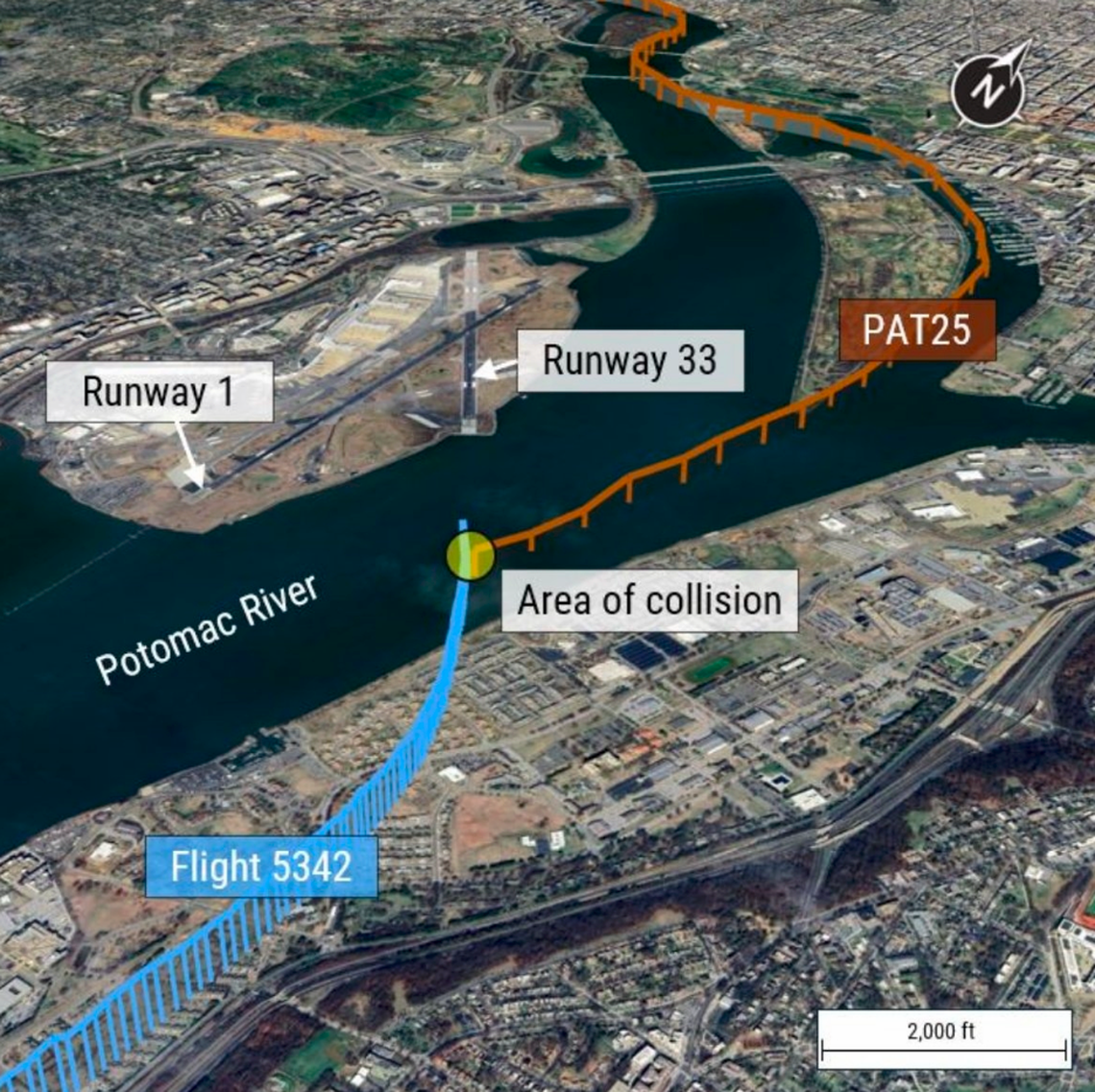
The paths of American Eagle Flight 5342 (blue) and a U.S. Army UH-60 Black Hawk helicopter (orange) that collided over the Potomac River near Washington Reagan National Airport on Jan. 29, 2025. (NTSB)
The midair collision outside Washington that killed 67 people did not come down to a single bad moment in the cockpit. Investigators now say it was the product of a “terrible” structural choice in how aircraft are funneled in and out of the nation’s capital, compounded by equipment failures and human assumptions. Nearly a year after the Jan. 29, 2025 crash, the emerging picture is less about freak misfortune and more about a system that set two crews up to fail.
What has surfaced in recent days is a blunt verdict: the disaster over the Potomac River was 100 percent preventable, and the design of the airspace itself is now in the crosshairs. That finding is already rippling through debates over how much risk is acceptable in the crowded skies around D.C., and who should be held to account when “never again” turns out to be wishful thinking.
The “terrible” airspace call that set up a deadly crossing
At the heart of the new findings is a choice that safety officials now describe as a “terrible design of the airspace.” The pilots of an American Airlines commuter jet and an Army Black Hawk helicopter were effectively put on intersecting tracks over the Potomac, with little technological backup to keep them apart. The National Transportation Safety Board has now framed that layout as the central misstep that turned routine traffic into a fatal geometry problem.
In its public hearing, The NTSB board homed in on how controllers and pilots were expected to rely heavily on visual cues in one of the country’s most complex pieces of airspace. That approach, which leaned on “visual separation” rather than robust electronic safeguards, left both crews vulnerable when things started to go wrong. By the time anyone realized the two aircraft were converging, there was no margin left to recover.
Instrument failures, wrong assumptions, and 67 lives lost
Layered on top of the flawed layout were technical and human errors that made a bad setup lethal. Investigators identified an instrument failure in the Army helicopter that likely made its crew believe they were flying 100 feet higher than they actually were. That bad data fed into a chain of assumptions between the controller and the helicopter pilots about where the rotorcraft sat in relation to the jet.
On the jet side, the crew of the American Airlines commuter flight was following clearances that, on paper, should have kept them safely separated. Instead, the two aircraft met in the same slice of sky, killing all 67 people aboard the jet and the helicopter. The NTSB’s summary of the tragedy, which unfolded just outside Washing, underscores how a single faulty gauge and a misplaced confidence in visual separation can erase every other layer of training and procedure.
“NEED TO KNOW” and the warning signs that went ignored
What stings for families and safety advocates is how many red flags were already on the table. Internal briefings labeled as NEED and KNOW material had already flagged the D.C. corridor as a place where a single distraction or misread could have catastrophic consequences. Authorities have now confirmed that the probable cause of the Jan. 29, 2025 collision included a controller looking at the wrong plane while traffic stacked up, a mistake that played out exactly as earlier risk assessments had feared.
In a recap of the hearing, Copy The Link style live coverage highlighted how EST timestamps and technical testimony kept circling back to one theme: the alert systems on both crafts were not enough to overcome the structural and procedural gaps that had been tolerated for years.
About the Author