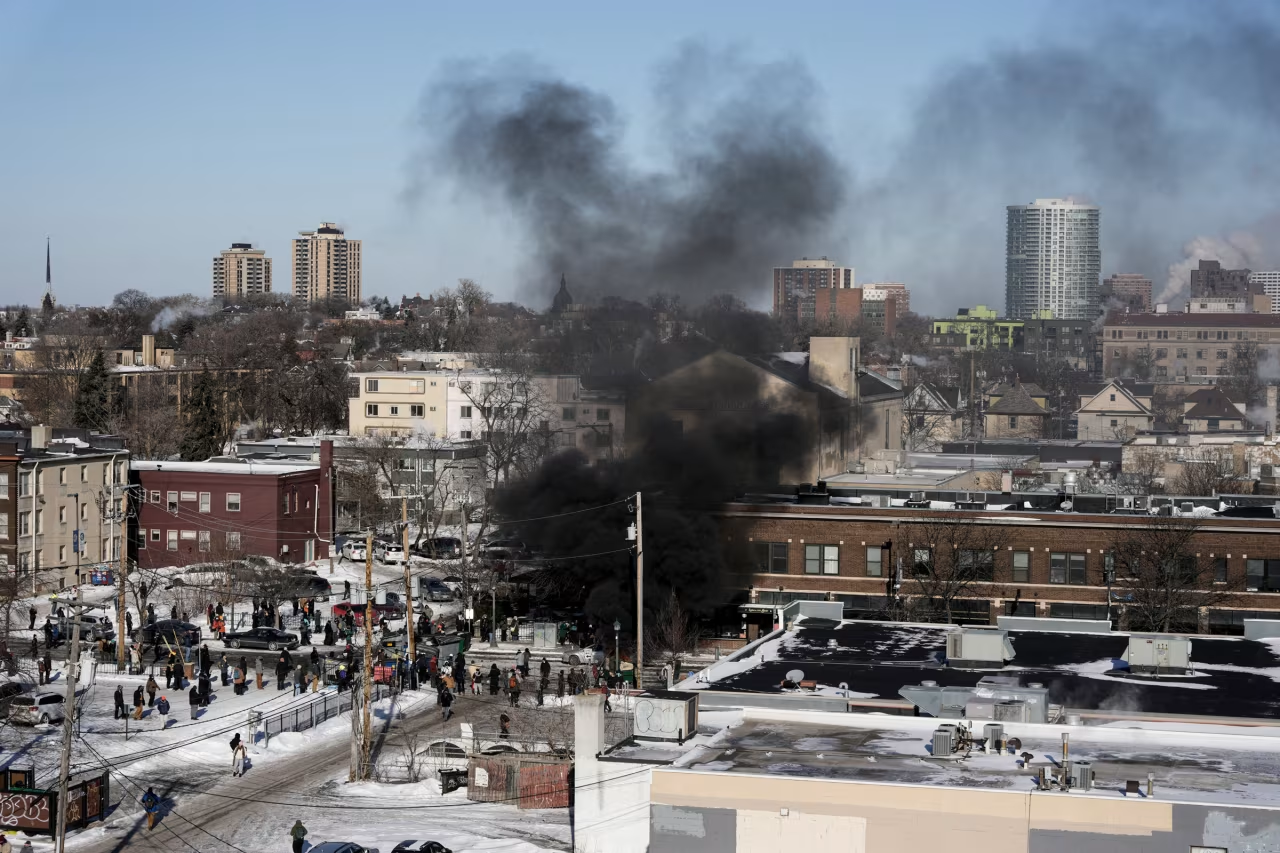
Smoke from burning dumpsters rises, during clashes between federal agents and community members in Minneapolis, on Saturday. Tim Evans/Reuters
Witness accounts of the killing of Alex Pretti in Minneapolis have zeroed in on a single, haunting detail: a pediatrician at the scene says Border Patrol agents shifted the wounded man’s body to tally bullet holes instead of starting CPR. In a case already loaded with questions about force, training, and basic humanity, that allegation has become a shorthand for everything that may have gone wrong in those chaotic minutes. It is now central to legal filings, public outrage, and a growing debate over how federal agents handle medical emergencies they themselves create.
What happened on that Minneapolis street is still being picked apart by investigators and lawyers, but the broad outlines are clear enough to be chilling. Federal immigration agents opened fire, Alex Pretti went down, and a doctor living nearby ran toward danger, expecting to help save a life. What he says he found instead was a scene that looked less like an emergency response and more like a grim inventory.
The chaotic shooting and a doctor’s blocked path
According to a government report to Congress, two federal agents fired their weapons after CBP personnel tried to take Pretti into custody and a struggle broke out. The report says CBP personnel attempted to detain him, that Pretti resisted, and that During the confrontation shots were fired, leaving him critically wounded on the pavement, a sequence now under intense scrutiny in Washington and Minneapolis alike, as officials review the CBP account. A separate overview of the incident notes that after the gunfire, Pretti was left on the ground and later died at the scene, a stark endpoint that has turned every decision in those final minutes into potential evidence in a wrongful death case, as detailed in the killing timeline.
Among the people who rushed toward the commotion was a 29‑year‑old pediatrician who lived nearby and heard the shots. He has described how his view of the initial altercation was partially obstructed, but he says that within seconds he saw at least four ICE agents with guns trained on Pretti, then watched as the man collapsed and lay motionless on the street, a moment he later recounted in detail while criticizing the ICE agents’ response. He has said he immediately identified himself as a physician and tried to get to the victim, only to be met with drawn weapons and shouted commands instead of a request for help.
“Counting bullet holes” instead of CPR
The pediatrician’s most explosive claim is not about the shooting itself, but about what happened after the gunfire stopped. In sworn testimony and court filings, he says Border Patrol agents physically moved Pretti’s body, rolling or shifting him in a way that looked less like a medical maneuver and more like an effort to count entry and exit wounds, even as precious seconds ticked by without chest compressions. He has framed that choice as a basic betrayal of emergency protocol, arguing that any trained responder should prioritize airway, breathing, and circulation over what he describes as a kind of on‑scene forensics, a point that now sits at the heart of the public allegations.
In a more detailed account submitted in litigation, the same doctor says he repeatedly told agents he was a physician and wanted to treat Pretti, but that they instead focused on moving the body and visually inspecting the injuries. He describes finally reaching the victim, checking for a pulse, and starting CPR himself after feeling none, a sequence that has been echoed in descriptions of his testimony that refer to him as The Minneapolis pediatrician who tried to intervene while agents, in his telling, were more interested in Scene Says Agents Were Counting Wounds than in basic life support, as laid out in the sworn account.
A doctor’s fight to take over care and the fallout for Border Patrol
The pediatrician’s frustration did not end with that first attempt to reach the victim. He has said that when he rushed in and announced he was a doctor, Border Patrol agents demanded to see his identification before letting him anywhere near Pretti, even as the man lay bleeding on the ground. According to his description, the scene was so tightly controlled by armed officers that he had to argue his way into doing chest compressions, a delay he believes cost critical time, a claim that has been highlighted in reporting on When Border Patrol. Another account notes that one agent on scene shouted, “I need scissors, I need someone to cut this s***,” while others focused on securing the perimeter, even as officers insisted on seeing the doctor’s medical identification before allowing him to take charge, a detail that underscores how long it took for trained civilian care to begin, as described in coverage that emphasized how Among the witnesses, the pediatrician was uniquely qualified to help yet still held back, according to those on scene.
About the Author