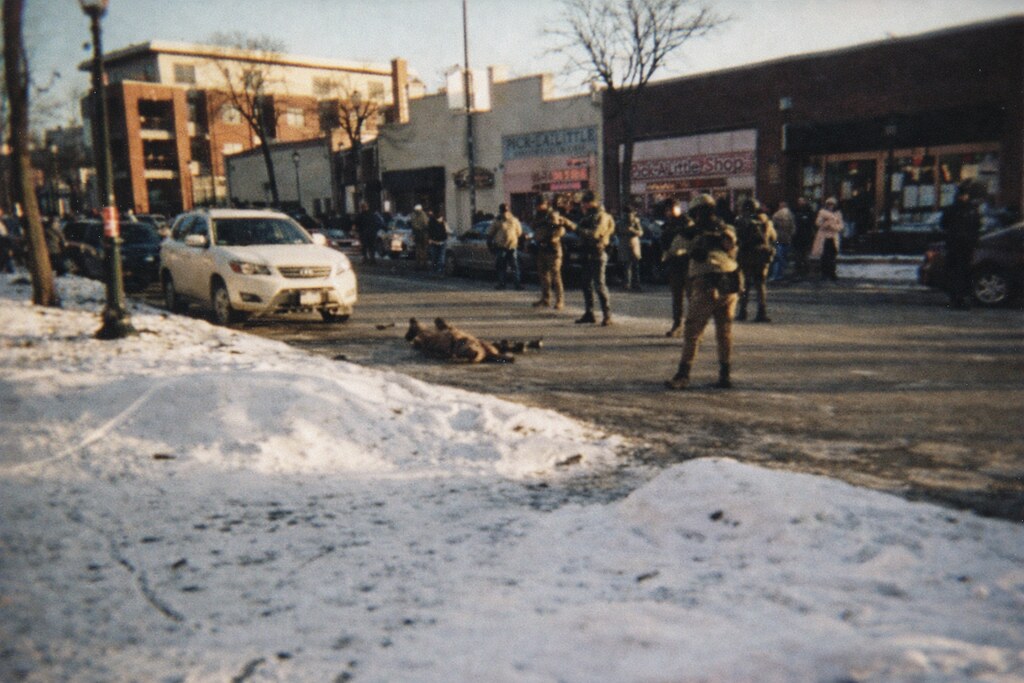
a colorized 1990s Disposable Camera Look-style AI generated image representing the shooting of Alex Pretti
The killing of Alex Jeffrey Pretti in Minneapolis has already become a flashpoint in the national fight over policing and immigration. Now an old Charlie Kirk riff on the Second Amendment, resurfacing across social platforms, is pouring gasoline on that fire. The viral clip is not just another culture-war sound bite, it is colliding in real time with raw questions about state power, public safety, and who pays the price when political theory meets a man’s final moments on a city street.
As details about the confrontation that left the 37-year-old intensive care nurse dead continue to emerge, the resurfaced comments are being treated by critics as a kind of confession about the acceptable “cost” of an expansive gun culture. Supporters, meanwhile, are rallying around Kirk’s framing of armed citizens as a necessary check on government force, even when that force is carried out by the same federal agents now under scrutiny in Minneapolis.
The Pretti shooting and a country already on edge
To understand why a Second Amendment monologue is suddenly everywhere, it helps to start with what is known about the final hours of Alex Jeffrey Pretti. According to a detailed Timeline, federal agents shot and killed Pretti after tracking him through Minneapolis in what authorities described as a rapidly escalating encounter. Officials have said they believed he posed an imminent threat, pointing to a sequence of confrontations that unfolded almost Moment by Moment Look in the streets and parking lots of the city, and they have emphasized that the operation was part of a broader push against violent offenders. That account, laid out in an Updated Jan briefing, is already being challenged by activists who see a familiar pattern in the way deadly force is justified after the fact.
Separate reporting on the Killing of Alex fills in key biographical and situational gaps. On January, the 37-year-old American intensive care nurse for the United Stat government was described as having been involved in a tense encounter in which he allegedly held his arm around the woman during a struggle that drew law enforcement attention. That mix of personal detail and contested behavior has turned Pretti into a kind of Rorschach test, with some seeing a dedicated caregiver pushed past his limits and others focusing on the risk he may have posed in the minutes before the shots were fired.
Inside the federal apparatus, the fallout has been swift and unusually public. Border agents involved in the fatal shooting have been placed on administrative leave while the incident is investigated, a step confirmed in an internal summary that notes how border agents tied to the operation were sidelined shortly after the confrontation. That same account points readers to a broader explainer about ICE, underscoring how the shooting is now inseparable from long-running debates over immigration enforcement and the reach of Homeland Security. When the government’s own personnel are benched while investigators sort out what happened, it sends a signal that the official story is not the final word.
Conflicting narratives and the clip that caught fire
Even before the leave decisions, fresh video had already complicated the government’s version of events. Unearthed footage shows Alex Pretti scuffling with federal officers in Minneapolis days before the shooting, a scene that shows him resisting as agents try to detain him, then breaking away and sprinting off when they let go. The clip, recorded in WASHINGTON and circulated widely, has been used by defenders of the operation to argue that Pretti had a pattern of confrontational behavior with law enforcement. For critics, it instead raises questions about why a man who had already slipped away from officers in a nonlethal encounter ended up dead the next time they crossed paths.
Those doubts only deepened when an internal review began to contradict the White House narrative of how the operation unfolded. A document described as being prepared By Ximena Bustillo and reviewed by NPR points to discrepancies between what federal officials said publicly and what investigators later pieced together from radio traffic and body camera footage. A picture at a memorial to Alex Pretti in Minneapolis, Minn has become a quiet counterpoint to those dueling accounts, a reminder that the argument is not just about process but about a man whose death is now being litigated in press conferences and court filings.
Into that swirl of grief and mistrust dropped a familiar face from the conservative media ecosystem. Earlier this week, a post about the Second Amendment from Charlie Kirk began ricocheting across platforms after being flagged in coverage of the Pretti case. One write-up noted that the post, originally shared on Jan, triggered a Media Error when users tried to play the embedded video, a small technical glitch that did nothing to slow down the spread of the underlying quote. The resurfaced comments, which framed gun deaths as an unfortunate but acceptable trade-off for a heavily armed populace, landed very differently in a week when a federal operation had just ended with a nurse bleeding out on the pavement.
About the Author