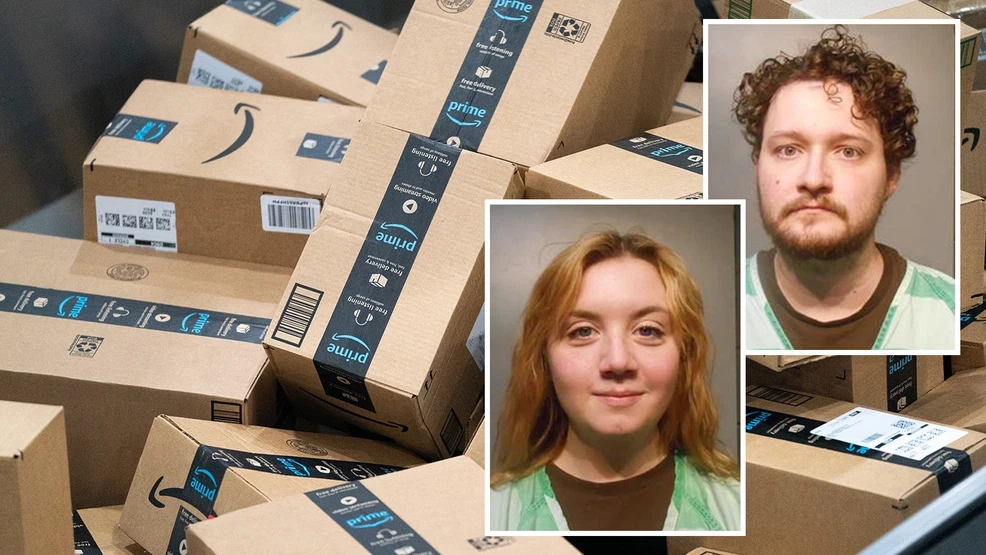
A couple pled guilty to stealing almost $58,000 in packages while the pair worked as delivery drivers for Amazon. (Polk County Sheriff's Office, Photo by Sean Rayford/Getty Images)
Package theft is usually a crime of opportunity, a stranger grabbing a box off a porch and disappearing. What unfolded in Iowa was something different: a coordinated, inside job that turned routine Amazon routes into a personal shopping spree worth nearly $58,000 in stolen goods. The case, now ending in guilty pleas, is a sharp reminder that the weakest link in the delivery chain is sometimes the person wearing the uniform.
Instead of quietly dropping off orders, two drivers treated their routes like a catalog, keeping what they were supposed to hand over. The fallout stretches far beyond one neighborhood, raising questions about how platforms vet gig workers, how quickly companies spot patterns of missing items, and what customers can realistically do to protect themselves.
How a delivery side hustle turned into a $58,000 theft ring
The scheme centers on Brandon and Madison Kelderman, an Iowa couple who signed up as Brandon and Madison through Amazon Flex, the app based program that lets drivers use their own cars to deliver packages. Instead of treating the gig as a flexible side job, investigators say the pair turned it into a pipeline for stolen merchandise, quietly diverting boxes that were supposed to land on customers’ doorsteps. Working regular routes in Iowa, they allegedly kept package after package, counting on the sheer volume of Amazon deliveries to hide the pattern for as long as possible.
That pattern eventually became impossible to ignore. Internal tracking flagged a suspicious spike in undelivered orders tied to the Couple’s routes, prompting Amazon’s loss prevention team to dig in. According to police in ALTOONA, Iowa, the trail led straight to the pair’s home, where officers later reported finding stacks of items that should have been scattered across local porches instead. By the time the numbers were tallied, the Couple working as Amazon drivers were accused of stealing roughly $58,000 in customer packages in less than a month, a haul that turned a side hustle into a full blown fraud case.
Inside the guilty pleas and what investigators uncovered
Once the stash was uncovered, the legal process moved quickly. The couple, who had been operating as Amazon Flex drivers in ALTOONA, Iowa, were tied to a wave of missing orders that had triggered complaints from frustrated customers. Company investigators shared route and delivery data with local officers, who then checked the couple’s residence in Altoona. They reported finding at least two pallets worth of goods that should have been in customers’ hands, a visual snapshot of just how fast the thefts had piled up.
Confronted with that evidence, the Couple changed course in court. Earlier this year, both drivers entered guilty pleas, admitting to a coordinated plan to keep packages instead of delivering them. Federal court documents described the operation as a Package Theft Scheme that exploited the trust built into Amazon’s logistics system. The total value, pegged at about $58,000 in stolen merchandise, lines up with earlier reports that the Couple working as Amazon delivery drivers stole $58,000 worth of customer packages in a matter of weeks, not years.
What this means for Amazon customers and the wider delivery economy
For shoppers, the case lands at an awkward moment. Online orders are now default for everything from groceries to prescription refills, and most people barely think twice about leaving a box on the porch. Stories like this one, where Amazon Delivery Drivers Admit to a $58k Fraud Scheme of Keeping Customers’ Packages, chip away at that easy trust. Customers may get refunds or replacements, but they are still left dealing with delays, reordering hassles, and the uneasy sense that someone with direct access to their home address decided to cash in on it.
The fallout also stretches into the broader gig economy that powers so much of modern delivery. Amazon leans heavily on flexible programs like Amazon Flex, which rely on quick sign ups and app based oversight rather than traditional, tightly supervised employment. When that model fails, regulators can and do step in. Consumer protection rules already allow authorities to levy steep penalties for companies that mishandle customer experiences, with Violations carrying civil fines of up to $2,500 for a first offense and $5,000 for each subsequent one when rules are broken. While the Kelderman case is a criminal matter focused on the drivers themselves, it adds pressure on Amazon and other platforms to prove that their systems can catch insider theft quickly, keep customers whole, and avoid turning doorstep delivery into a high risk bet.
About the Author