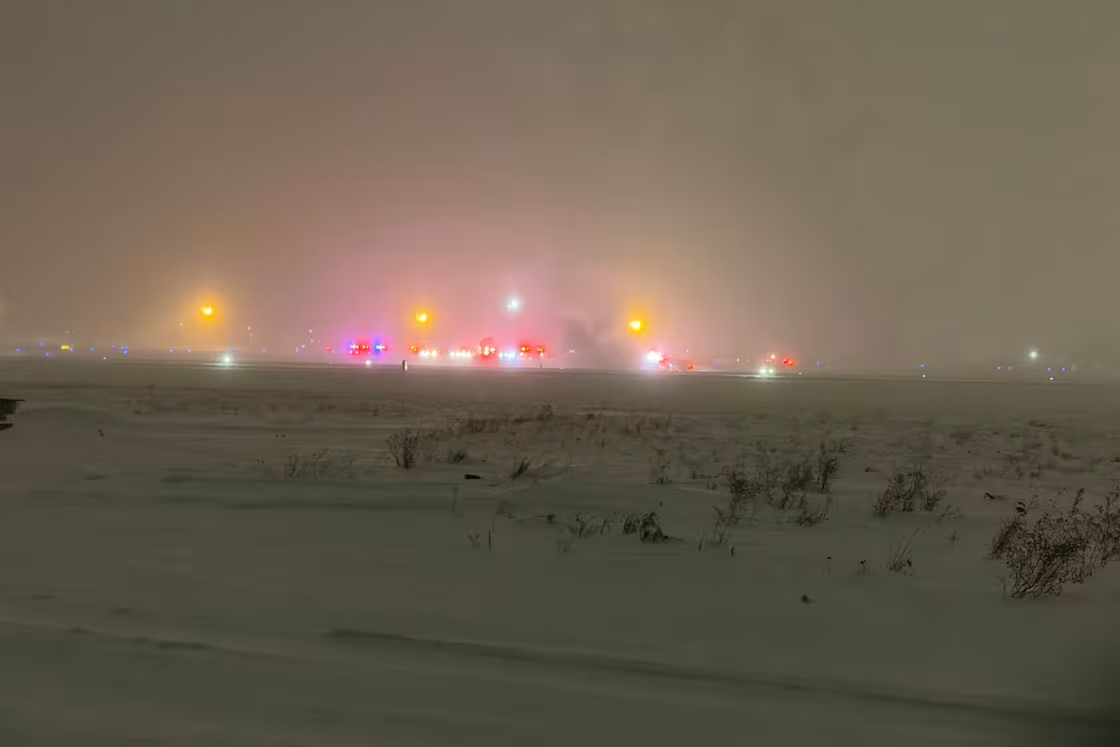
Lights in the distance Sunday night after a private Bombardier Challenger 600 jet crashed at Bangor International Airport in Maine.@3315Aviation
A winter storm, a runway slick with snow and a private jet loaded for an overnight flight to Europe came together in the worst possible way at Bangor International Airport in Maine. The crash that followed killed six people on board, with early confusion over the toll briefly fueling reports of a seventh victim and a lone survivor before federal officials clarified the numbers. What has emerged since is a picture of a high-end business trip that ended in fire, twisted metal and a growing list of families grieving across several states and as far away as Hawaiʻi.
The jet never made it far from the ground. It rolled, lifted into the storm and then slammed back down near the runway, flipping upside down and burning in full view of airport workers and first responders. In the days since, investigators and relatives have been trying to reconcile that violent end with the ordinary details that led up to it, from a refueling stop in Maine to the Paris-bound itinerary that had started in Houston.
The crash on a stormy Bangor runway
The private aircraft went down during takeoff at Bangor International Airport as a heavy snowstorm swept across the Northeast, cutting visibility and coating the airfield. The jet was attempting to depart for Paris when it failed to climb, skidded off course and came to rest inverted, according to an updated account from the FAA. The impact ruptured fuel lines and the aircraft erupted in flames, leaving an airfield filled with smoke and debris as emergency crews raced in. Early statements suggested that seven passengers and the pilot might have been involved, but the agency later corrected its own preliminary figures and now says six people were on board and all six died.
Witness accounts and radio traffic captured in the aftermath describe a chilling final sequence in which the Jet struggled in the storm before slamming down near the end of the runway. Federal investigators have identified the aircraft as part of The Bombardier Challenger 600 family, a line that, as one safety analysis notes, “has a history” of serious incidents tied to approach and takeoff performance, including accidents within roughly 600 m of the runway threshold. While it is far too early to say whether design, maintenance or pilot decision-making played the decisive role here, investigators are already zeroing in on how the winter storm, runway conditions and aircraft performance intersected in those final seconds.
From Houston to Paris, with Bangor as a deadly stop
The trip itself started in Houston, Texas, where the jet was linked to a prominent personal injury law firm, Arnold & Itkin. The Plane was carrying firm partners, relatives and friends on a business and leisure trip to France, with Bangor serving as a refueling point before the overnight leg to Paris. According to the According to the Federal Aviation Administration, the private jet had departed Houston and stopped in Maine to refuel before continuing across the Atlantic, a routine routing that turned catastrophic when the storm intensified over New England.
Airport officials initially told reporters that, according to the flight manifest, there were six people on the aircraft, a figure later echoed in a news release shared by the airport. Separate coverage of the same crash, citing early federal summaries, briefly described a scenario in which seven people had died and one person survived with serious injuries, with one outlet framing it as “7 dead, 1 survived” and another noting that Maria Pasquini reported on a passenger, aged 37, who was seriously injured. Those accounts have since been overtaken by the FAA update that there were six people on board and six deaths, with no surviving passenger, a correction that underscores how chaotic the first hours after a crash can be.
Victims’ stories and a grim month for small jets
As the wreckage cooled, attention shifted to the people who never made it out. Relatives and colleagues have confirmed that the dead include partners and family members tied to the Houston firm, including a well-known Texas attorney’s wife, whose death was noted in early reports that showed Emergency vehicles surrounding the Maine crash site. Another victim was a Hawaiian chef with deep ties to the islands, identified as the fourth person publicly named in the crash, part of a group that had turned a work trip into a chance to see France. Federal summaries and local obituaries have filled in more detail, including one passenger, aged 53, highlighted in Details that sketched out careers, families and the kind of everyday plans that make a sudden loss feel even sharper.
The geographic spread of the grief is striking. Two of the dead had Hawaiʻi connections, according to Federal Aviation Administration details, while others were rooted in Houston and Maine. One report described how the Private jet bound for France left behind children in ninth, fifth and second grades, while another piece on the Maine crash emphasized how quickly a professional milestone trip turned into a mass-casualty event. For the families, the debate over whether there were six or seven victims is academic; what matters is that every seat on that jet is now a story cut short.
About the Author